Affiliate Program Guide: How to Earn Commission Honestly (and Keep Earning)
How an affiliate program works and how to earn commission without spamming: choosing programs, reading the terms, recurring vs one-off commission, audiences, disclosure, and what realistic earnings look like.
On this page
Affiliate marketing has a reputation problem, thanks to endless "earn $5,000 a week" posts and comment sections full of spam links. Done honestly, it's much simpler and more durable: you recommend a product you actually use to people who need it, and you earn a share of what they pay. This guide explains how an affiliate program works, how to choose one, and how to earn commission without annoying anyone or breaking the rules.
How affiliate programs work#
An affiliate program pays you a commission when someone you referred, through your personal link, signs up for or buys a product. The steps are the same almost everywhere:
- You join the program and accept its terms.
- You get a personal referral link.
- Someone clicks your link, and the program remembers the referral for a set number of days.
- If they sign up and pay within that period, the sale is credited to you.
- After a holding period, which covers refunds, the commission is paid out.
Read the terms before you share a link#
Programs differ a lot in the details, and the details decide what you actually earn:
- Commission rate: the percentage or fixed amount per sale.
- What it applies to: the first purchase only, or renewals too?
- How long it recurs: one payment, a set number of months, or for life?
- Tracking period: how long after a click a sign-up still counts.
- Holding period: how long before commission becomes payable.
- Payout: how you're paid, minimum amounts and fees.
- Rules: what promotion is banned, such as spam, paid ads on the brand name, or self-referrals.
Recurring commission is worth far more than one-off commission for subscription products. A 25% commission on a monthly plan that the customer keeps for a year pays twelve times.
Choose products you'd recommend anyway#
The single best predictor of affiliate success is whether you genuinely use and like the product. Recommendations from real experience convert better, and they don't cost you your audience's trust. Ask yourself:
- Have I used it for a real task, and did it work?
- Would I recommend it to a friend if there were no commission?
- Do the people I know actually need it?
- Is the company honest about pricing and easy to cancel?
If the answer to any is no, skip it, however high the rate.
Find the people who need it#
Affiliate income comes from reaching the right people, not the most people. Good places to share a recommendation:
- Your own content: a blog post, video or social post showing how you use the product for a real job.
- Your clients: if you're a consultant, developer or accountant, recommending tools that solve their problems is part of the service.
- Communities where you already help people, following each community's rules on links.
- Your email list or WhatsApp contacts who opted in to hear from you, with a genuinely useful message.
What doesn't work, and gets you banned from programs: dropping links in unrelated comments, sending them to people who never asked, or creating fake reviews.
Disclose, clearly#
People deserve to know when you earn from a recommendation. A short line near the link is enough: "I may earn a commission if you sign up through this link, at no extra cost to you." In many countries this is a legal requirement; the US Federal Trade Commission's guidance on endorsements is a widely used reference. Disclosure rarely reduces sign-ups; people appreciate honesty, and hiding it damages trust when they find out.
The Tekservix Partner Program#
If you use Tekservix tools, such as WAservix for WhatsApp, SMS Gora, the AI tools or a Tekservix plan, the Tekservix Partner Program pays commission on what the customers you refer spend on membership plans, AI credits, WAservix and SMS Gora. How it works:
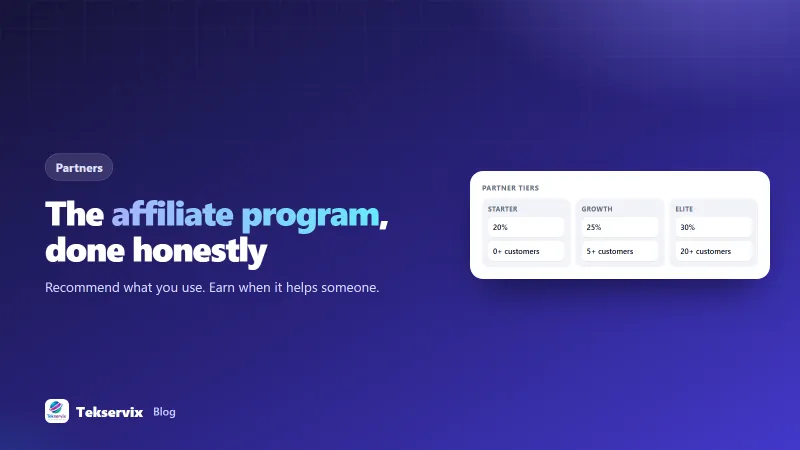
- Tiered commission based on how many paying customers you've referred: 20% to start, 25% from 5 paying customers, and 30% from 20.
- Recurring for 12 months: commission covers the customer's payments for the first 12 months after they sign up, including renewals.
- One link, any page: add your referral code to any Tekservix page link, so you can point people straight to the tool they need. A referral is remembered for 60 days after the click.
- A refund window, then your wallet: commissions are held for 14 days in case of a refund, then credited to your Tekservix wallet, from which you can withdraw to your bank or digital wallets or spend on Tekservix.
- Fair rules: new customers only (existing accounts can't be referred), and refunded or fraudulent purchases don't earn.
The strongest partners tend to be people who already help businesses: web developers adding WhatsApp or SMS notifications for clients, accountants recommending invoicing tools, and trainers teaching AI tools. Our guides to the WhatsApp API for business and bulk SMS are good pages to point people to.
What realistic earnings look like#
Most affiliates start small: a few referrals in the first months, mainly from people they already know. Income grows when you have a steady source of the right audience, such as a blog post that ranks, a video that keeps getting views, or a client base that keeps needing the product. Think in terms of helping ten businesses well rather than reaching ten thousand strangers.
A worked example#
Imagine a freelance web developer who builds sites for small shops. For each new client, she sets up WhatsApp order notifications and recommends the tool she uses, mentioning that she earns a partner commission. Over a year, 12 clients sign up for paid plans through her link. Once she passes five paying customers, her rate rises to 25%, and because commission recurs for each customer's first 12 months, every new client adds income month after month. She never posted a link in a stranger's comments; she just recommended what she already used, openly.
Frequently asked questions
How does an affiliate program work?
You share a personal link to a product. When someone signs up or buys through your link, the program tracks the referral and pays you a commission, usually a percentage of what the customer spends, after a holding period for refunds.
How much can you earn from an affiliate program?
It depends on the commission rate, the product's price, whether commission recurs, and above all how many genuinely interested people you reach. Most affiliates earn modest amounts at first; steady income comes from recommending products you use to an audience that trusts you.
Do I have to disclose affiliate links?
Yes, in many countries, and it's good practice everywhere. Say clearly, near the link, that you may earn a commission. Consumer protection authorities such as the US Federal Trade Commission require clear disclosure of paid relationships.

Tekservix Team
The team behind Tekservix
The Tekservix Team builds and supports Tekservix: WhatsApp and SMS APIs, AI tools, invoicing, PDF and SEO tools for growing businesses. We write practical, tested guides based on what we see our customers do every day.
More articles from the Tekservix Team