Can You Use AI Images Commercially? Rights, Risks and Practical Rules
Most AI image tools let you use what you create in your business, but 'allowed by the tool' isn't the whole story. Here's what to check before using AI images commercially: terms, copyright, trademarks, people's likenesses and disclosure.
On this page
- Step one: read the tool's terms
- Step two: understand the copyright question
- Step three: avoid other people's rights
- Trademarks and brands
- Copyrighted characters and artworks
- People's likenesses
- Step four: don't mislead customers
- Step five: check platform and disclosure rules
- Safe uses for most businesses
- Uses that need extra care
- What about AI images bought from stock sites?
- Agencies and freelancers: tell your clients
- A simple checklist before you publish
- Creating images for your business
AI image generators can produce a polished ad visual, a blog header or a product scene in seconds. For businesses that used to pay for stock photos or shoots, that's a big deal. The obvious next question is if you're actually allowed to use these images in your marketing, on your website or on products you sell.
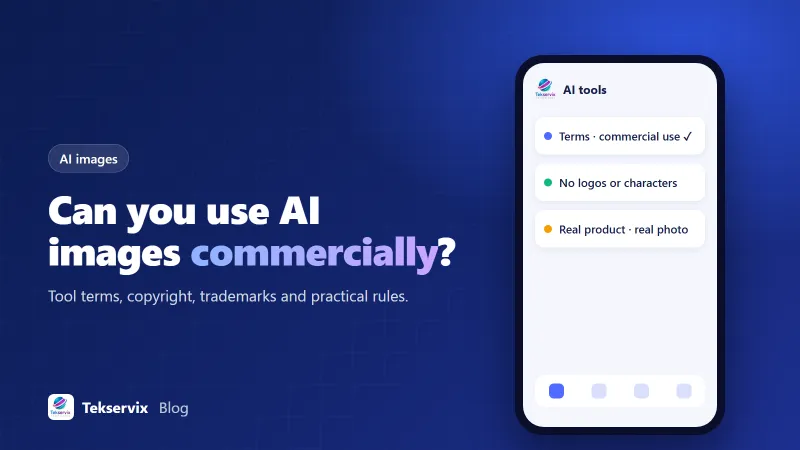
So, can you use AI images commercially? In most cases, yes, but "the tool allows it" is only one part of the answer. Here's what to check, in plain language. It's a practical guide, not legal advice; for high-stakes uses, talk to a lawyer in your country.
Step one: read the tool's terms#
Every AI image service has terms of use that say what you can do with the output. Common patterns:
- Many tools grant you broad rights to use what you generate, including commercially.
- Some restrict commercial use on free plans and allow it on paid ones.
- Some keep a licence for themselves to use your images, for example to improve the service or show examples.
- Almost all prohibit generating certain content: illegal material, deceptive impersonations, or infringing content.
Read the terms for the specific plan you use, and save a copy dated when you generated important images, since terms change.
Step two: understand the copyright question#
This is where things are genuinely unsettled. Copyright traditionally protects works created by humans. The US Copyright Office has stated that content generated entirely by AI, without enough human creative control, isn't eligible for copyright protection, though human-made parts of a work (your own edits, selection and arrangement) can be. Other countries are taking a range of positions, and courts are still working through cases.
What this means in practice:
- You can usually use the image, but you may not be able to stop others from copying it.
- For a logo or brand mark you want to protect, relying purely on an AI-generated design is risky. Use AI for ideas, then have a designer create the final version, or modify it substantially yourself. Our guide to AI logo makers covers this.
- Keep records of your prompts and edits for important assets, in case authorship ever matters.
Step three: avoid other people's rights#
The bigger practical risk isn't who owns your image. It's whether your image uses something owned by someone else.
Trademarks and brands#
Don't generate images featuring other companies' logos, branded products or recognisable packaging for your marketing. An AI-generated scene with a famous drinks brand's can on the table is still using their trademark.
Copyrighted characters and artworks#
Prompts asking for a famous cartoon character, a film scene or "in the style of" a specific living artist can produce images that infringe or come uncomfortably close. Avoid them for commercial work.
People's likenesses#
Generating a realistic image of a real person, especially a celebrity, for an advert can violate publicity or personality rights in many countries, and implies an endorsement that doesn't exist. Many tools ban this. Generated people who don't resemble anyone real are generally safer, but check the tool's rules for using them in ads.
Step four: don't mislead customers#
Consumer protection rules apply to images just as they do to words. If you sell physical products, images should show the product accurately: colour, size, materials, what's included. Placing a real product photo into a generated background is fine. Generating a product that looks better than the real one is not. Our guide to AI product photography explains a workflow that stays on the right side of this.
The same goes for results-based imagery. A generated "before and after" for a fitness or skincare product is misleading if it implies real customer results.
Step five: check platform and disclosure rules#
Some advertising platforms and marketplaces have rules about AI-generated or AI-edited content, particularly for political, social or health-related ads and for realistic depictions of people or events. Some jurisdictions are introducing requirements to label synthetic media in certain contexts. Before running AI-generated visuals in paid campaigns, check the platform's current ad policies.
Safe uses for most businesses#
- Blog headers, illustrations and social media graphics.
- Backgrounds and lifestyle scenes around real product photos.
- Concept visuals for presentations, pitches and mood boards.
- Abstract or illustrative images for ads, without real people, brands or characters.
- Placeholder images while waiting for a real shoot.
Uses that need extra care#
- Logos and brand marks you want to protect.
- Product packaging and merchandise you'll sell in volume.
- Realistic images of people in advertising.
- Anything in regulated areas such as health, finance or children's products.
- Images that recreate a recognisable style, place or design closely associated with another business.
What about AI images bought from stock sites?#
Many stock photo libraries now sell AI-generated images alongside traditional photos, often with a label. Buying from a reputable stock site doesn't remove every question, but it shifts some of the work: the site's licence tells you what uses are allowed, and some offer indemnity on certain plans. Read the licence as you would for any stock image, check whether the image is marked as AI-generated, and apply the same checks for brands, characters and people.
Agencies and freelancers: tell your clients#
If you create content for clients, say in your contract or brief whether you use AI tools, for what, and which rights you transfer. Some clients ban AI-generated imagery; others welcome it. A clear line in the agreement avoids an awkward conversation after delivery.
A simple checklist before you publish#
- Does the tool's current plan allow commercial use?
- Does the image contain any logo, brand, character, artwork or real person you don't have rights to?
- Does it accurately represent what you're selling?
- Does the platform you're publishing on have rules about AI content?
- Is it important enough to need copyright protection? If so, add real human design work.
Creating images for your business#
The Tekservix AI image generator is built for everyday business visuals: social graphics, blog headers, product scenes and ad concepts. Read the terms for your plan, keep brands and real people out of your prompts, and use real product photos where accuracy matters. Do that, and AI images become a practical, low-risk tool rather than a legal headache waiting to happen.
Frequently asked questions
Do I own the copyright to images I generate with AI?
It depends on the country and how much human creativity went into the image. The US Copyright Office has said that material generated entirely by AI isn't protected by copyright, though human-authored elements and arrangements can be. Other countries take different approaches.
Can I use AI images in ads and on products I sell?
Usually, if the tool's terms allow commercial use, and the image doesn't infringe someone else's trademark, copyrighted character or likeness. Read the terms of the specific tool and plan you use, as free and paid tiers sometimes differ.
Can I generate images of real people or celebrities for marketing?
Avoid it. Using a recognisable person's likeness in commercial content without permission can violate publicity or personality rights in many countries, and many tools prohibit it outright.

Tekservix Team
The team behind Tekservix
The Tekservix Team builds and supports Tekservix: WhatsApp and SMS APIs, AI tools, invoicing, PDF and SEO tools for growing businesses. We write practical, tested guides based on what we see our customers do every day.
More articles from the Tekservix Team