How to Write a Deposit Invoice (and Show It Correctly on the Final Bill)
Asking for money upfront protects your time and cash flow, but it needs to be done clearly. Here's how to write a deposit invoice, how much to ask for, and how to show the deposit on the final invoice so the numbers always add up.
On this page
Asking for money before you've done the work can feel awkward, especially early in a business. It shouldn't. A deposit protects you from clients who disappear halfway through, covers costs you have to pay upfront, and signals that both sides are committed. Most serious clients expect it.
The trick is doing it cleanly. A clear deposit invoice, followed by a final invoice that shows exactly what's been paid and what's left, avoids the confusion that turns small sums into big arguments. Here's how.
When a deposit makes sense#
Not every job needs one, but these situations almost always do:
- You'll buy materials or stock specifically for the client.
- You're reserving a date and turning down other work for it, as photographers, venues and event suppliers do.
- The project is long, and you'd otherwise work for weeks before seeing any money.
- The client is new and you have no payment history with them.
- The work is custom and hard to sell to anyone else if the client backs out.
How much to ask for#
There's no universal rule, but some common patterns:
- 25 to 50 percent of the total for services like design, consulting or development.
- The full cost of materials, plus a share of labour, for trades and custom manufacturing.
- A fixed booking fee for date-based services, such as weddings and events.
- Milestone splits for long projects, for example 30/40/30.
Base the figure on your real exposure. If walking away halfway through would cost you $2,000 in materials and lost bookings, a $300 deposit doesn't protect you.
Check local rules before setting a figure. Some places limit deposits for certain consumer services, such as home improvement work.
What to put on a deposit invoice#
A deposit invoice is a proper invoice, not a casual request. Include:
- Your business details and the client's details.
- A unique invoice number in your normal sequence.
- The invoice date and due date. Deposits are usually due on signing or before a start date.
- A clear description: "Deposit (40%) for website redesign per proposal P-2026-118 dated 6 October 2026."
- The total project value, so the client sees the deposit in context.
- The deposit amount, plus tax if applicable.
- Whether the deposit is refundable, and under what conditions.
- Payment methods.
Referencing the proposal or contract ties the deposit to what was agreed and makes the final invoice easier later.
Refundable or non-refundable?#
Decide this before you send anything, and write it down in the contract and on the invoice.
A non-refundable deposit, often called a booking fee or retainer, compensates you for reserving time or turning away work. It's common for weddings, events and anything date-specific.
A refundable deposit is returned if certain conditions are met, for example if the client cancels more than 30 days before the start date, or if you can't deliver. It's friendlier for some clients but offers you less protection.
Be careful with wording. In some legal systems, a "deposit" and a "part payment" are treated differently if a contract is cancelled, and an excessive non-refundable amount can be challenged. If large sums are involved, get the contract wording checked.
Tax on deposits#
In many countries, sales tax or VAT is due when you receive a payment, including deposits. In the UK, for instance, a deposit generally creates a tax point for VAT when it's received. Other countries have different rules, and refundable security deposits are sometimes treated differently from advance payments. If you're tax-registered, confirm the treatment with your accountant, and show tax on the deposit invoice if it applies.
Showing the deposit on the final invoice#
This is where most confusion happens. The final invoice should show the full value of the work, then subtract what's been paid, so the client can see the whole picture at a glance:
- Website redesign, per proposal P-2026-118: $4,800.00
- Additional landing page, change request 12 Oct: $400.00
- Subtotal: $5,200.00
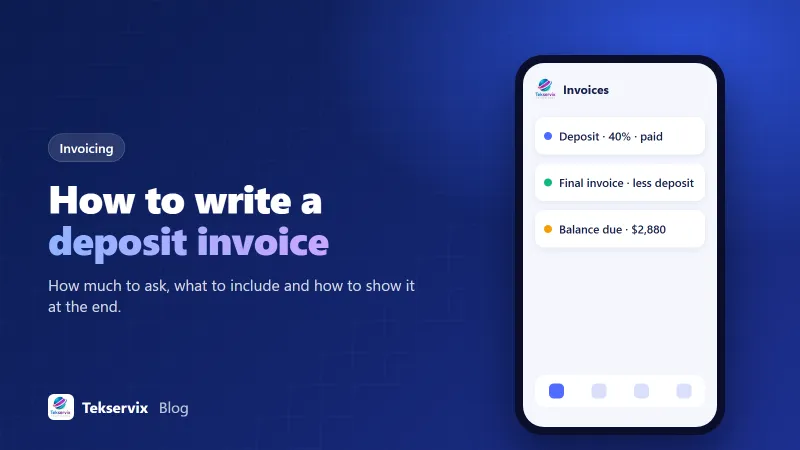
- Less deposit received 8 October 2026 (invoice INV-0412): −$1,920.00
- Balance due: $3,280.00
Reference the deposit invoice number and the date it was paid. If tax applies, make sure it's calculated correctly across both invoices, so the client isn't charged tax twice on the deposit portion. Good invoicing software handles this; spreadsheets often don't.
Milestone payments work the same way#
For projects paid in stages, each stage gets its own invoice, and the final one shows the total, every payment received with its invoice number, and the remaining balance. A running summary on each invoice ("Paid to date: $3,000 of $10,000") reassures clients that nothing is billed twice. Our guide to contractor invoices shows a full progress billing example.
When the project is cancelled#
If a client cancels after paying a deposit, follow what the contract says and document it. For a non-refundable deposit, send a short written note confirming the cancellation and that the deposit is retained under the agreed terms. For a refundable one, refund promptly, by the same method the client paid, and keep a record. If you've done part of the work, many contracts let you keep the portion of the deposit that covers it and refund the rest. Issuing a credit note for any refunded amount keeps your books straight; our guide to credit notes explains how.
What if the client won't pay a deposit?#
It happens. Some large companies have procurement rules against upfront payments. Options include smaller milestone payments, invoicing the first milestone very early, or shorter payment terms on each invoice. For a new client who refuses any upfront commitment on a big custom job, think carefully about the risk. A client unwilling to pay anything before work starts may be telling you something about how payment will go at the end.
Do it the same way every time#
Consistency makes deposits feel normal to clients. Put the deposit terms in your proposals, send the deposit invoice the moment the client agrees, and don't start work until it's paid. The Tekservix invoice generator lets you create the deposit invoice and the balance invoice from the same details, so the numbers line up. If you're also deciding on general payment terms, our guide to invoice payment terms has wording you can copy.
Frequently asked questions
What is a deposit invoice?
A deposit invoice requests part of the total price before work starts or goods are delivered. It's a real invoice with its own number and due date, and the amount paid is later deducted from the final invoice.
How much deposit should I ask for?
It depends on your costs and risk. Many service businesses ask for 25 to 50 percent. If you must buy materials or turn down other work for the client, a higher deposit or the full cost of materials upfront is reasonable.
Do I charge sales tax or VAT on a deposit?
In many tax systems, yes: tax becomes due when the payment is received, even if it's a deposit. Rules differ by country and by whether the deposit is refundable, so check with an accountant for your situation.

Tekservix Team
The team behind Tekservix
The Tekservix Team builds and supports Tekservix: WhatsApp and SMS APIs, AI tools, invoicing, PDF and SEO tools for growing businesses. We write practical, tested guides based on what we see our customers do every day.
More articles from the Tekservix Team