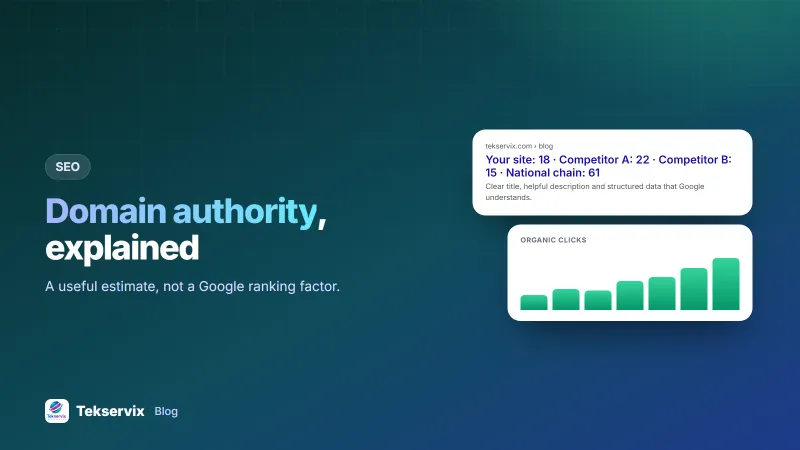
Domain Authority Explained: What the Score Means and What It Doesn't
Domain authority explained in plain terms: who makes the score, how it's calculated, why Google doesn't use it, how to read it sensibly, why it changes, and what actually improves a site's standing.
On this page
Sooner or later, someone emails offering to "boost your DA to 50", or a report shows your site with a domain authority of 12 and a competitor with 35. It sounds like a grade from Google. It isn't. Domain authority is a useful estimate made by SEO tools, and understanding what it measures, and what it doesn't, stops you wasting money on the wrong goal.
What domain authority is#
Domain Authority (DA) is a score from 1 to 100 created by the SEO software company Moz to estimate how likely a website is to rank in search results compared with other sites, based mainly on the links pointing to it. Moz explains its method on its Domain Authority page.
Other tools have their own versions under different names, such as Domain Rating or Authority Score. They're calculated differently, so the same site gets different numbers in each tool. Compare scores only within the same tool.
How it's calculated, roughly#
Each tool crawls the web, counts the links pointing to each site, and weighs them by the strength of the linking sites. The result is placed on a scale where a few huge sites sit near the top. Two features of that scale matter:
- It's relative. Your score depends on how your links compare with everyone else's, so it can move when other sites change, even if nothing changed on yours.
- It's logarithmic. Moving from 20 to 30 is much easier than moving from 70 to 80. Small sites climb quickly at first; large sites barely move.
What Google thinks of it#
Google doesn't use domain authority or any other third-party score. It has its own ranking systems, which consider many factors beyond links, such as relevance to the search, content quality, page experience and location. A site with a lower third-party score can outrank one with a higher score, especially for specific or local searches.
So the score is a rough proxy for one part of SEO, the strength of your link profile, as seen by one tool's crawler. It's not a measure of your site's quality, and it's not what decides your rankings.
How to use the score sensibly#
- Compare with direct competitors, not with Wikipedia or national news sites. If the businesses ranking above you for your key searches all have much stronger link profiles, links are probably one of the gaps.
- Watch the trend over months, not the number on a single day.
- Judge link opportunities roughly: a link from a respected industry site with a strong score is usually worth more than one from an empty directory.
- Don't set it as a goal. Traffic, enquiries and sales are goals; the score is at most a signpost.
Why your score changes#
- You gained or lost links. Check your backlink report for the reason.
- The tool updated its index or formula. Scores across the web shift when a tool recalculates.
- Other sites grew. Because the scale is relative, your score can fall when others gain links faster.
A drop in a third-party score doesn't mean Google demoted you. Check your actual rankings and traffic before worrying; our rank tracker guide shows how.
What actually improves your standing#
Anything that earns genuine links from relevant, trusted sites helps both your real rankings and, as a side effect, third-party scores:
- Listings with suppliers, partners and associations you work with.
- Local press coverage and community involvement.
- Useful content, data or tools that others cite.
- Fixing broken links to your site with redirects.
Our guide on how to get backlinks goes through each, and checking backlinks explains how to see what you already have. The Tekservix SEO tools include a backlink checker, site audit and rank tracker to follow the things that matter.
Links are only part of it. Clear pages that answer searchers' questions, good titles, a fast mobile site and a complete Google Business Profile often matter more for a business than another ten points of any score.
Beware of "DA boost" offers#
Offers to raise your domain authority quickly usually mean buying links from networks of low-quality sites built to inflate scores. They can push the third-party number up while doing nothing for rankings, or harm them: Google's spam policies treat bought links as manipulation. A higher score bought this way is a number on a report, not more customers.
A worked example#
Imagine a local accounting firm whose owner is worried because its score is 14 while a national firm's is 58. The owner checks the searches that matter, such as "accountant in [City]" and "business tax help [City]", and finds the local firm already ranks in the top five for several, above the national firm, because its pages are specific to the city and its Google Business Profile is complete. The competitors that do outrank it locally have scores around 20 to 25, with links from the regional business association and local news. The firm joins the association, writes a guide to local tax deadlines that the association shares, and gets a local news mention for a free tax clinic. Six months later its score is 21, and more importantly, it ranks for two more local searches that bring enquiries.
Frequently asked questions
Does Google use domain authority?
No. Domain Authority is a score created by the SEO company Moz, and similar scores come from other tools. Google has its own ranking systems and doesn't use any third-party authority score. The scores are estimates of how a site's links compare with others.
What is a good domain authority score?
There's no universal good score. It's a relative measure, so compare your site with direct competitors in your market rather than aiming for a number. A local business with a lower score than a national brand can still outrank it for local searches.
How can I increase my domain authority?
Earn links from relevant, trusted websites, the same things that help real rankings. Don't buy links to raise the score; that breaks Google's rules and a higher third-party score doesn't bring customers by itself.

Tekservix Team
The team behind Tekservix
The Tekservix Team builds and supports Tekservix: WhatsApp and SMS APIs, AI tools, invoicing, PDF and SEO tools for growing businesses. We write practical, tested guides based on what we see our customers do every day.
More articles from the Tekservix Team