Receipt Template: What a Proper Receipt Includes (With a Free Layout)
A receipt template for businesses: what every receipt should show, a copyable layout, receipts for cash, digital wallets and deposits, numbering, digital receipts, tax rules and record keeping.
On this page
A customer pays you by digital wallet and asks for a receipt. You scribble one on a piece of paper, or send a screenshot of the payment message, and move on. Months later, the customer's accountant needs it, or you need to prove a payment in a dispute, and neither document helps. A proper receipt template takes the guesswork out: every receipt shows the same information, in the same place, with a number you can find later.
What a receipt is for#
A receipt is a document that confirms a payment was received: who paid, how much, for what, when and how. It protects both sides. The customer can prove they paid; you can prove what you received and for which sale. It's different from an invoice, which asks for payment; our guide to invoice vs receipt explains when you need each.
What every receipt should include#
- Your business details: name, address, phone, and tax number if you're registered.
- The word "Receipt" clearly at the top.
- A unique receipt number in a continuous sequence.
- The date of payment.
- The customer's name, for business customers and larger amounts.
- What was paid for: items or services, with quantities and prices, or a reference to the invoice being paid.
- The amount paid and the currency.
- Tax, shown separately if you charge it.
- The payment method: cash, digital wallets, card, bank transfer, with a transaction reference where there is one.
- The balance due, if this was a part payment.
- A signature or stamp for handwritten receipts.
A layout you can copy#
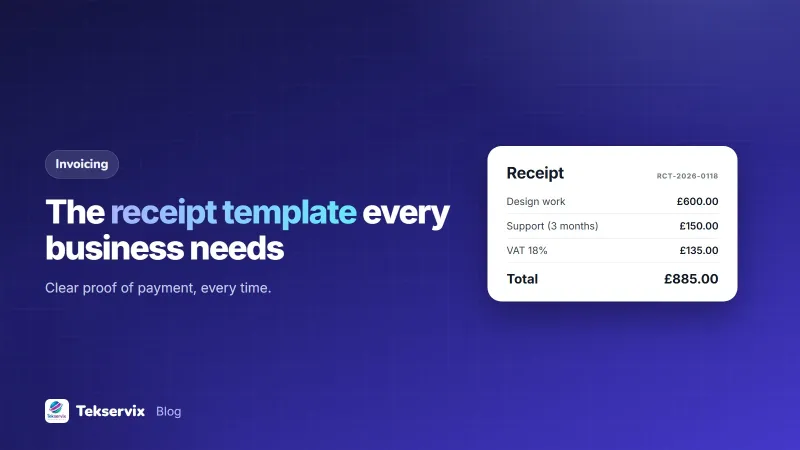
RECEIPT
[Business name] · [Address] · [Phone] · TIN [number]
Receipt no: RCT-2026-0118 · Date: 7 November 2026
Received from: [Customer name]
For: Invoice INV-2026-0187, office chairs (20 units)
Amount received: $1,200
Payment method: Digital wallet, ref. TX74839201
Balance due: $1,200 (due 30 November 2026)
Received by: [Name, signature]
Keep the most important line, the amount received, easy to find. For simple shop sales, the "For" line becomes a short list of items with prices.
Receipts for different situations#
Cash#
Cash leaves no automatic record, so the receipt is the only proof for both sides. Always give one, keep a copy, and count the cash in front of the customer. Record the payment in your books the same day.
Digital wallets and bank transfers#
The payment message is not a receipt; it doesn't say what the payment was for. Issue your own receipt that includes the transaction reference, and link it to the invoice or order. That's what makes month-end matching quick.
Deposits and part payments#
State clearly that it's a deposit, what it's for and what remains: "Deposit of 50% for kitchen cabinets, order 0441. Balance of $900 due on installation." Issue a new receipt for each later payment, showing the updated balance.
Refunds#
When you refund, document it just as carefully, with a refund receipt or credit note that refers to the original sale. Our guide to the credit note covers corrections and returns.
Numbering#
Give receipts their own sequence, separate from invoices, such as RCT-2026-0001 onwards. Never reuse a number, and don't delete a receipt made in error; cancel it and note why. A continuous sequence shows your records are complete, which matters to accountants and tax authorities. The same principles as for invoices apply; see the invoice number format guide.
Digital receipts#
Many customers prefer a PDF receipt on WhatsApp or email: it doesn't fade, get lost or need a drawer. Digital receipts also make your own records searchable. Name files clearly, such as Receipt-RCT-2026-0118.pdf, and send them as soon as payment arrives.
The Tekservix invoice generator has a receipt document type, with your business details saved, automatic numbering suggestions and your choice of currency. You can create and preview receipts for free; downloading the finished PDF uses credits or a plan.
Tax rules#
Rules about receipts vary by country and by whether you're registered for VAT or sales tax. In countries with mandatory e-invoicing, such as Italy, Mexico and India, invoices and receipts must go through an approved electronic system; our guide to VAT invoice requirements explains the details. If you're registered for VAT anywhere, check what your tax authority requires on each receipt.
Keeping receipts, both ways#
Keep copies of every receipt you issue and every receipt you receive for business expenses. Tax authorities expect records to back up your income and costs; the US IRS, for example, explains which business records to keep, and many countries have similar rules and minimum retention periods. Scan paper receipts you receive, because thermal paper fades within months. Our guide to tracking business expenses suggests a simple system.
A worked example#
Imagine a furniture maker who takes a 50% deposit by digital wallet for a dining table. They issue receipt RCT-2026-0118 stating it's a deposit for order 0441, with the transaction reference and a balance of $900 due on delivery. On delivery, the customer pays the rest in cash, and receipt RCT-2026-0131 shows the final payment and a balance of zero. Both PDFs go to the customer on WhatsApp and into the maker's records. At year end, every payment for order 0441 is traceable in seconds, and the customer's company claims the purchase without a single follow-up question.
Frequently asked questions
What should a receipt include?
Your business name and contact details, a unique receipt number, the date, what was paid for, the amount paid, the payment method, and any tax shown separately. For part payments, show the balance still due.
Is a receipt the same as an invoice?
No. An invoice asks for payment; a receipt confirms that payment was received. Many sales have both: an invoice first, then a receipt once the customer pays. For instant sales, the receipt may be the only document.
Can I send receipts digitally?
Yes, as a PDF by email or WhatsApp, which many customers prefer because it's easy to keep. Check local tax rules: in some countries, such as the US for VAT-registered businesses, receipts must come from an approved electronic billing system.

Tekservix Team
The team behind Tekservix
The Tekservix Team builds and supports Tekservix: WhatsApp and SMS APIs, AI tools, invoicing, PDF and SEO tools for growing businesses. We write practical, tested guides based on what we see our customers do every day.
More articles from the Tekservix Team