Recurring Invoice Guide: Billing Retainers, Subscriptions and Monthly Clients
How to handle a recurring invoice properly: when to use one, agreeing terms, numbering, dates and periods, changes mid-cycle, automatic vs manual sending, reminders and a monthly routine.
On this page
Monthly clients are the backbone of many businesses: a cleaning contract, a bookkeeping retainer, website maintenance, a software subscription, office rent. The work is steady, so the billing should be too. A recurring invoice that goes out on the same day every month, with the same clear layout and the right period, gets paid on schedule. One that arrives late, with last month's dates copied by mistake, gets queried and delayed.
When a recurring invoice fits#
- Retainers: a fixed fee for ongoing availability or a set amount of work each month.
- Subscriptions and memberships: software, gyms, clubs, maintenance plans.
- Rent and leases for equipment, space or vehicles.
- Service contracts: cleaning, security, IT support, gardening.
- Instalment plans agreed for a larger purchase.
What they have in common: the same client, a predictable amount, and a regular schedule.
Agree the terms first#
A recurring arrangement needs a written agreement, even a short one, before the first invoice. Cover:
- The amount and what it includes, such as "up to 10 hours of support".
- The billing cycle: monthly, quarterly, yearly.
- In advance or in arrears: billed at the start of each period, or after it.
- The invoice date and due date, such as "invoiced on the 1st, due by the 10th".
- What happens to extras: work beyond the retainer, and how it's billed.
- Price reviews: when and how the fee can change.
- How either side can end it, and the notice period.
Our guide to the freelance contract shows where these terms usually go.
What each invoice must show#
A recurring invoice is still an ordinary invoice, with everything an invoice needs: your details, the client's details, a unique number, the date, a description, the amount, tax where applicable, and how to pay. In the UK, for example, GOV.UK lists what every invoice must include, and other countries have similar rules.
Two details matter especially for recurring invoices:
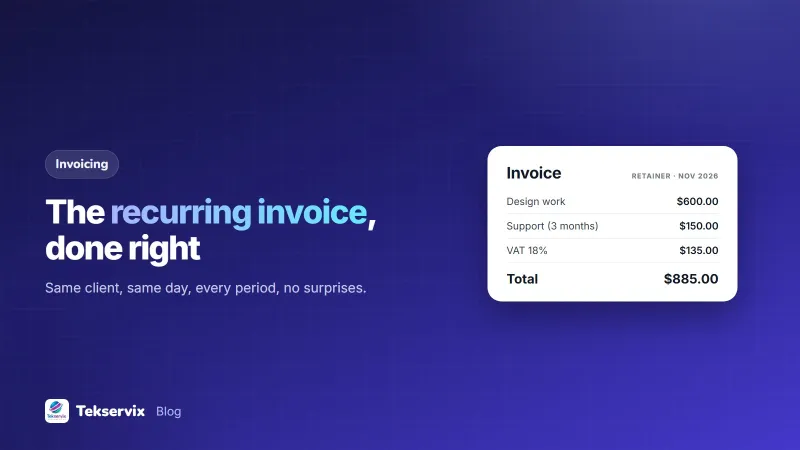
- The billing period, stated clearly: "Website maintenance retainer, 1-30 November 2026." Without it, the client's accounts team can't tell whether this is a new charge or a duplicate.
- A new invoice number every time. Never reuse a number because it's "the same invoice". You can reference the agreement on each one ("as per agreement of 1 March 2026") so they group together easily. See our guide to the invoice number format.
Advance or arrears#
Fixed retainers and subscriptions are usually billed in advance, at the start of the period. You're paid for the month before or while you do the work, and a client who stops paying can be paused before you've done much unpaid work.
Variable work, such as hours on top of a retainer or usage-based fees, is usually billed in arrears, at the end, once you know the amount. Many businesses combine the two on one invoice: this month's retainer in advance, plus last month's extra hours in arrears, each on its own line with its own period.
Changes mid-cycle#
- Starting mid-month: bill a pro-rated first invoice for the days remaining, then move to the regular cycle.
- Upgrades or downgrades: apply from the next cycle unless you agreed otherwise, and say so on the invoice.
- Price increases: give notice as the agreement requires, and mention the new amount in the message sent with the first invoice at the new price.
- Cancellation: send a final invoice for the notice period, and confirm in writing that no further invoices will follow.
Automatic or manual?#
Some invoicing and accounting systems can create and send recurring invoices automatically on a schedule. That's convenient for large numbers of identical invoices, but it has a risk: a mistake repeats every month until someone notices. Whatever you use, review each cycle's invoices before they go out, even if it's a two-minute check.
If you issue a handful of recurring invoices a month, doing them by hand from saved details is quick and keeps you in control. The Tekservix invoice generator doesn't schedule invoices automatically, but it saves your invoices to your account, remembers your business details, lets you pick a saved client, and suggests the next invoice number, so a monthly invoice takes a couple of minutes. Set a calendar reminder for the day they're due to go out.
Send on the same day every time#
Consistency trains clients to pay on schedule. Pick a day, such as the 1st or the last working day of the month, and never miss it. Late invoices lead to late payments, and an irregular pattern means the client's accounts team never builds your invoice into their routine.
Send a short message with each invoice: the number, period, amount and due date in the first line. "Invoice INV-2026-0214 for the November retainer, C$350 due 10 November."
Late payers on recurring contracts#
Recurring clients who pay late cost more than one-off clients, because the delay repeats. Handle it early:
- Send a reminder a few days before the due date for the first few cycles.
- Follow up promptly on overdue invoices; our payment reminder email templates cover each stage.
- If a client is regularly late, talk to them. Moving the due date to match their payment run often solves it.
- Agree in the contract what happens when invoices go unpaid, such as pausing the service after 30 days.
A monthly routine#
- On the billing day, create each recurring invoice with the new period and number.
- Add any extras from last month as separate lines.
- Check each total and period, then send.
- On the due date, match payments and remind anyone who hasn't paid.
- Once a quarter, review each recurring client: is the fee still right for the work?
A worked example#
Imagine an IT support company with 14 monthly clients on retainers. On the 1st of each month, the office manager spends about half an hour creating invoices from saved client details: each has a new number, the month's period, the retainer billed in advance and any extra hours from the previous month in arrears. Due dates are the 10th. On the 8th, clients who haven't paid get a friendly reminder. One client who always paid around the 20th agrees to a due date of the 20th instead, and stops being "late". Cash arrives on predictable days, and the quarterly review shows two clients whose retainers no longer cover the work, so their fees are adjusted with a month's notice.
Frequently asked questions
What is a recurring invoice?
A recurring invoice is one you send to the same client on a regular schedule, such as monthly or quarterly, for an ongoing service or subscription. Each one is still a separate invoice with its own number, date and billing period.
Do recurring invoices need a new invoice number each time?
Yes. Every invoice, including each one in a recurring series, needs its own unique number in your sequence. You can reference the agreement or contract on each invoice so they're easy to group.
Should I bill at the start or the end of the period?
Retainers and subscriptions are usually billed in advance, at the start of the period. Usage-based or hourly work is usually billed at the end, once you know the amount. State which you use in your agreement.

Tekservix Team
The team behind Tekservix
The Tekservix Team builds and supports Tekservix: WhatsApp and SMS APIs, AI tools, invoicing, PDF and SEO tools for growing businesses. We write practical, tested guides based on what we see our customers do every day.
More articles from the Tekservix Team

