WAservix vs respond.io: A respond.io Alternative for Teams That Only Need WhatsApp
respond.io is a powerful omnichannel inbox for teams. Many of its buyers only use WhatsApp, though. Here's how a flat-fee WhatsApp API compares, and when the bigger platform earns its price.
On this page
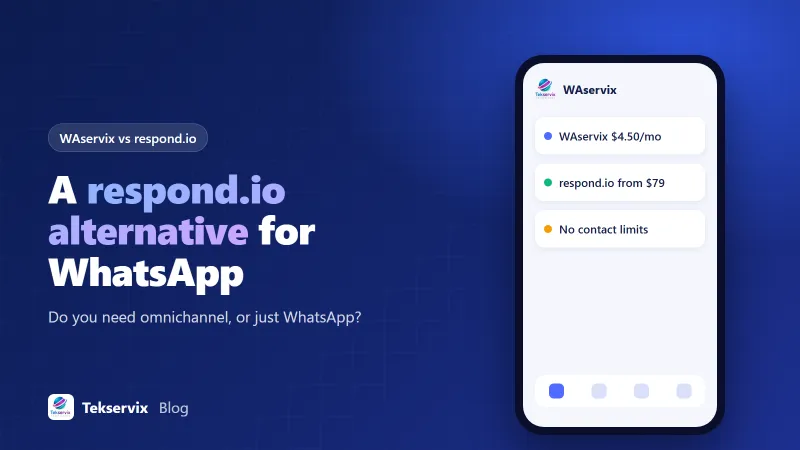
A good respond.io alternative depends on one question: how many channels do you truly use? respond.io is built for teams working WhatsApp, Instagram, Messenger, email and more from a single inbox, with routing rules and AI on top. If that's your day, it's a serious product. But a lot of the businesses paying for it live almost entirely on WhatsApp. For them, WAservix, which we make at Tekservix, offers a far simpler deal: $4.50 a month, your own number and unlimited messages.
Below, we'll compare the two on price, on what each one expects of you, and on the risks. And we'll say where we fall short.
Who needs a respond.io alternative?#
Usually it's one of three people: a founder who bought a big platform too early, a manager who can see that half the seats sit idle, or a developer who wants WhatsApp inside an existing system. All three want the same thing, which is fewer moving parts at a lower monthly cost.
Two products, two jobs#
respond.io is a conversation management platform. Its job is to make sure that when a customer contacts you on any channel, the right person answers, in the right order, with the right history in front of them. It's sold to sales and support teams, and it's priced for them.
WAservix is a messaging tool. Its job is to get messages to and from your WhatsApp number, by hand, in bulk or through your software. It's sold to anyone who wants that to be cheap and quick.
If you try to use one for the other's job, you'll be unhappy. A 30-agent contact centre shouldn't run on WAservix. A three-person shop shouldn't pay for a platform to route chats between three people who sit together.
Pricing compared#
| WAservix | respond.io | |
|---|---|---|
| Entry plan | $4.50/mo | $79/mo, billed yearly ($948/yr) |
| Mid plan | $12/mo (3 numbers) | $159/mo, billed yearly |
| Top self-serve plan | $79/mo (25 numbers) | $279/mo, billed yearly |
| Users | Account based | 5 to 10 included, extra seats $12 to $24 |
| Contact-based pricing | No, unlimited contacts | Yes, monthly active contacts |
| Meta message fees | None | Yes, on official channels |
| Other channels | WhatsApp, plus SMS through SMS Gora | Many, in one inbox |
respond.io's figures come from its pricing page on 30 October 2026. The page's visible prices differed from its hidden metadata, which listed $99, $199 and $349, likely the monthly-billing rates. So confirm the numbers yourself before you budget.
Contact-based pricing: the thing to watch#
Pricing on monthly active contacts feels fair until something goes well. A viral post, a seasonal rush or a big reactivation campaign can push your active contacts past your tier in a few days. On Growth, overage is listed at $12 per 100 contacts, and on Advanced it's $15. So one good campaign could cost more than you'd planned. That isn't a trap: it's how value-based pricing works, and larger teams accept it.
WAservix takes the opposite position. Contacts and messages are both unlimited, on every plan. Our only meter is the number of WhatsApp numbers you connect. A Black Friday spike changes nothing on your bill.
Where WAservix wins#
Cost is the obvious one. Across a year, a respond.io Starter plan is $948, plus Meta's fees. A WAservix Starter plan is $45 if you pay annually, and Meta isn't involved. If your use is mostly one-to-many notifications, that's a huge difference for the same job.
Speed is another. There's no channel setup with Meta, no template approval and no contact import planning for tiers. You can run a campaign today.
Then there's the developer angle. WAservix has a full REST API and webhooks on every plan, so you can plug WhatsApp into your own CRM rather than move your team into a new inbox. Plenty of firms already have a CRM they like. They don't want a second one.
And multi-branch businesses do very well. Ten WhatsApp numbers cost $35 a month in total on our Business plan. That lets every store or department have its own line, with no added fee per number from Meta.
The other useful point is what comes with a Tekservix account. SMS Gora adds real text messages from the same wallet, and the AI Sales Agent gives you automatic first replies on both channels without building workflows.
Where respond.io wins#
We'll be direct: if your customers reach you on five channels, WAservix can't help with the other four. respond.io's unified inbox, conversation routing, shift-based assignment, workflows and reporting are real strengths. A manager who needs to know first response times by agent will find those reports worth the money.
It also runs on official APIs, so your WhatsApp number won't face the ban risk a linked-device connection can. For a company with a large sales team, that alone may settle it. Meta doesn't approve linked-device automation, and a number that attracts complaints can be restricted without warning, whichever tool you use to send.
And respond.io has AI agents built into the platform, with credits included on its plans. If you want AI working inside your agents' inbox, that's a neat fit.
A test for your own team#
Pull your last month of conversations and sort them by channel. If WhatsApp is above 80 percent, ask whether you need a platform to manage the rest. A simple way to handle the remainder might be good enough: answer Instagram DMs in Instagram, and emails in email.
Next, count your agents. If there are more than five people answering chats at the same time, routing starts to matter and the inbox pays for itself. If it's two or three, it probably doesn't.
Finally, look at what your team actually clicks on. It's common to pay for workflows you set up once and rarely look at again. That's no one's fault, but it's a clue that you could get by with less.
What happens if you move#
A move from respond.io to WAservix has a few steps. Export contacts and conversation data first. Keep opt-out records. Decide which number you'll use: a number on an official channel would have to be released before it can link as a device, so most businesses use a separate number for the switch-over and warm it up. Rebuild your most-used saved replies as auto-replies, and connect any systems through webhooks.
Don't move everything at once. Start with one type of traffic, like appointment reminders, and keep the old inbox running in parallel for a few weeks. If your team doesn't miss it, cancel.
Where a hybrid makes sense#
Some companies keep an official number on respond.io for inbound sales and customer support, then use WAservix for operational notices. Staff alerts, delivery updates and internal reminders don't need routing or reports, and they don't need to sit in an agent's queue at all. Moving them off your main inbox tidies it up, and if those messages were template-based, the fees go away too.
Our view#
respond.io is worth its price when conversations are your product: many agents, many channels, serious reporting. WAservix is worth a look when WhatsApp is the channel and you'd like to stop counting contacts. Try it with a $1 three-day trial, using real customers who've opted in. See how far it takes you. Our WhatsApp API provider comparison lists the other options, and our piece on WAservix and SleekFlow looks at a similar platform.
Frequently asked questions
How much does respond.io cost?
Its pricing page shows Starter at $79 a month, Growth at $159 and Advanced at $279, all billed yearly, with Enterprise on request. Plans include a set number of users, and pricing depends on monthly active contacts. WhatsApp message fees from Meta are separate.
What is a monthly active contact?
It's a contact you've had a conversation with in the billing month. Pricing tied to these means your plan can grow with your audience, even if each person only messages once. WAservix doesn't count contacts.
Can WAservix handle a team of agents?
It can handle a small team sharing a number, but it's not a full omnichannel inbox with routing, workflows and reporting. If you have many agents on many channels, respond.io or a similar platform is the better tool.

Tekservix Team
The team behind Tekservix
The Tekservix Team builds and supports Tekservix: WhatsApp and SMS APIs, AI tools, invoicing, PDF and SEO tools for growing businesses. We write practical, tested guides based on what we see our customers do every day.
More articles from the Tekservix Team