WAservix vs Whapi.Cloud: A Whapi.Cloud Alternative at a Sixth of the Price
Both products link a WhatsApp number as a device and give you an API. So the comparison comes down to price, tools and what's bundled. Here's the detail, including where Whapi is the stronger choice.
On this page
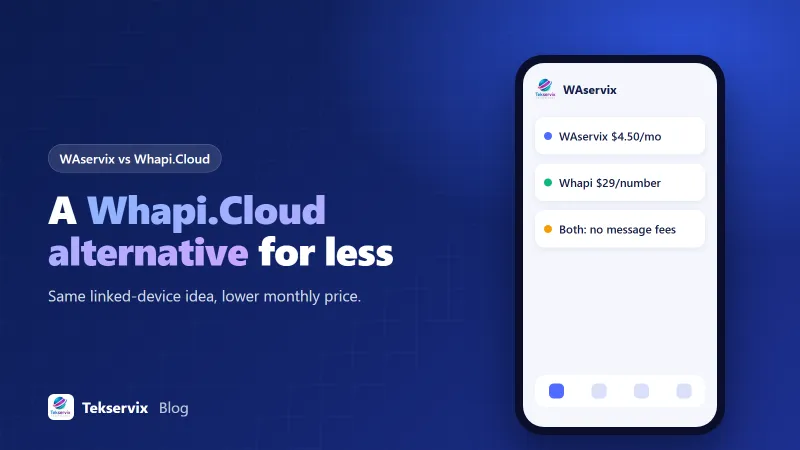
Here's the short answer for anyone comparing a Whapi.Cloud alternative: WAservix does the same core job for $4.50 a month, where Whapi charges $29 per number. Both link a WhatsApp number as a device. Both let you send without paying per message. We run WAservix, so naturally we like that sum, but price isn't the only thing a developer should look at. Whapi has put a lot of work into a broad API, and for some projects that's worth the difference.
Since the two products are so close, this comparison is unusually practical. You won't need to weigh official against unofficial, because they're on the same side of that line. You'll be choosing on price, tools and fit.
The Whapi.Cloud alternative in one table#
| WAservix | Whapi.Cloud | |
|---|---|---|
| One number | $4.50/mo | $29/mo |
| Three numbers | $12/mo total | Volume discount, ask them |
| Ten numbers | $35/mo total | Volume discount, ask them |
| Free tier | None, $1 trial for 3 days | Sandbox: 5 conversations a month, 150 messages a day |
| Paid trial | $1 | 5-day Premium trial |
| Message fees | None | None |
| Campaign screen | Included | Developer-first, check their dashboard |
| Auto-replies | Included | Build through the API |
| Bundled SMS | Yes, SMS Gora on one account | No |
| AI answering | AI Sales Agent, from $29/mo | Connect your own |
Whapi's figures are from its price page, checked on 30 October 2026, where the $29 is shown against a crossed-out $40.
What's the same#
Because both use a linked-device session, a lot of the experience is shared. You connect by pairing your number. Your phone keeps working. Nobody reviews templates. You can send media without worrying about Meta's categories, and you pay for access rather than for traffic.
The risk is shared too. Neither service is an approved Meta route. WhatsApp can act against any number that it thinks is abusing the network, and neither company can overturn that. If anyone tells you their linked-device API is ban-proof, walk away.
Where WAservix pulls ahead#
Price comes first, and at more than one number the gap only grows. Ten numbers on WAservix Business cost $35 a month in all. Even with a generous discount, ten Whapi channels start from a far higher base. For an agency running client numbers, or a chain with a line per branch, that adds up over a year to thousands of dollars.
Next is who can use it. WAservix has a dashboard with bulk campaigns and auto-replies, so your marketing person doesn't need a developer in the room. Whapi's pricing page describes it as a developer plan, and its tools reflect that. If your team is mixed, that matters.
Then there's the bundle. A Tekservix account runs WAservix, SMS Gora, the AI Sales Agent and the wider set of tools from one wallet. A developer can fall back from WhatsApp to SMS without opening a second vendor relationship, and there's no second invoice to chase.
Where Whapi.Cloud is stronger#
Whapi has invested in breadth. If your project relies on deep WhatsApp features such as groups, communities, channels, statuses and the like, read its API reference closely and compare it with ours. If it covers an endpoint you need and we don't, that endpoint is worth $24.50 a month to you.
Its free sandbox is handy too. Developers like being able to try an API with no payment at all. The limits are tight: five active conversations a month, 150 messages a day and 1,000 API requests a month, with a note about needing periodic activity. But for a hello-world test, it's enough.
And there's a comfort factor. Some developers would rather pay more for a specialist whose only business is this one API. That's a fair feeling.
A developer's checklist#
Before you commit to either, test these with real traffic:
- Does the webhook payload carry everything your code needs?
- How quickly do delivery status events arrive?
- What happens to queued messages if the session drops?
- How long does reconnection take, and can you detect a drop through the API?
- Does the provider rate-limit requests, and how does it tell you?
- How do you verify webhooks? On WAservix, the
X-Webhook-Signatureheader equals your device secret.
A cheap API that loses events costs more than an expensive one that doesn't. Spend an hour on this before you ship.
How to protect a number on either service#
Since both carry the same risk, the same habits apply. Start slowly. A new number shouldn't send hundreds of messages in its first days. Have real two-way conversations before you do anything automated. Add random delays between messages. Personalise text so it isn't identical across a batch. Stop messaging anyone who ignores you repeatedly, and remove anyone who asks.
The biggest danger is reports. When several people tap "report" in a short window, a number's standing falls quickly. Our opt-in guide helps you avoid that by making sure people expect to hear from you.
Costs over a year#
| Setup | WAservix (yearly plan) | Whapi.Cloud (at list price) |
|---|---|---|
| 1 number | $45 | $348 |
| 3 numbers | $120 | Up to $1,044 |
| 10 numbers | $350 | Up to $3,480 |
The Whapi column uses $29 a month with no discount, so real multi-number prices will be lower. Ask them for a quote if you're at that size. Annual billing is available at Whapi too, though its price wasn't listed on the page we read.
Support when a session drops#
Every linked-device service has the same bad day: a session ends, messages stop and somebody needs to fix it. Ask both vendors how you'll find out. Do you get a webhook, an email, or nothing? On our side, you can see each number's status in the dashboard. A simple scheduled test message to a staff phone also works well as a heartbeat, and it takes minutes to set up on any provider. Set an alert either way, because the worst outcome is finding out from a customer that your reminders stopped on Tuesday.
When switching isn't worth it#
If you've built a product around Whapi's specific endpoints, have a single number and everything works, saving $24.50 a month isn't worth the risk of a rewrite. Engineering hours cost more than that. Switching makes sense when you have several numbers, when you're starting something new, or when non-technical staff need access.
A sensible way to test: put your sending behind one function, add WAservix as a second provider, and route 10 percent of messages there. It'll take an afternoon, and you'll get real data.
Agencies: a special case#
If you run WhatsApp for clients, per-number pricing shapes your whole business model. At $29 a number, each client has to justify that cost before you've added a margin. At the WAservix Enterprise rate, $79 for twenty-five numbers works out at about $3.16 a number. You could include WhatsApp in a retainer without thinking about it, and a small client who'd never pay $29 becomes viable. The Green API comparison is worth reading if per-number cost is your main concern.
Our recommendation#
Starting fresh? Take the cheaper option and see if it does what you need. Three days and $1 on WAservix will show you. If you run into an endpoint we don't have, you can move to Whapi with no regrets. For those comparing the whole market, including official routes, our WhatsApp API roundup covers nine options.
Frequently asked questions
How much does Whapi.Cloud cost?
Its pricing page lists a free Developer Sandbox with tight limits, and Developer Premium at $29 per number per month, with discounts for several numbers. Premium includes unlimited messaging and a 5-day trial.
Are WAservix and Whapi.Cloud the same kind of product?
Very similar. Both connect a number as a linked device instead of using Meta's Business Platform, so neither charges per message. Both carry the same underlying risk if a number is used for spam.
Which has the better free trial?
Whapi offers a free sandbox with low limits and a 5-day Premium trial. WAservix charges $1 for a three-day trial of the full product with no message caps. Developers who only need a quick test may prefer the sandbox.

Tekservix Team
The team behind Tekservix
The Tekservix Team builds and supports Tekservix: WhatsApp and SMS APIs, AI tools, invoicing, PDF and SEO tools for growing businesses. We write practical, tested guides based on what we see our customers do every day.
More articles from the Tekservix Team