An AI Blog Writing Workflow That Produces Articles Worth Reading
A practical AI blog writing workflow: choosing topics from real questions, briefs, outlines, drafting in sections, adding experience and facts, editing for voice, checking originality, and publishing with care.
On this page
AI can draft a blog post in a minute. That's the problem: so can everyone else, and the web is filling with articles that say the same generic things in the same smooth voice. A good AI blog writing workflow uses the speed for the parts machines do well, such as outlines, first drafts and rewording, and keeps people in charge of what makes an article worth reading: real experience, checked facts, and a point of view.
Here is a workflow small teams can follow from topic to publish.
1. Start from real questions#
Pick topics your customers actually ask about, not topics an AI suggests. Sources that work:
- Questions from sales calls, WhatsApp chats and support emails.
- Google autocomplete and "People also ask" for your main terms. Our guide to Google autocomplete keywords shows how to mine them.
- Gaps in the current search results: questions they answer poorly or not at all.
One article, one main question. If you can't say in a sentence what the reader will be able to do afterwards, the topic isn't ready.
2. Write a brief before any prompt#
A brief is the difference between a generic draft and a useful one. Include:
- Reader: who they are and what they already know.
- Goal: what they should understand or do by the end.
- Key facts: your prices, process, numbers and examples, written out. The AI should work from these, not invent its own.
- Sources: official pages or studies you'll cite.
- Angle: what you believe that others don't say. This is what makes the piece yours.
- Voice: a paragraph from your best existing article as a style sample.
3. Get an outline, then fix it#
Ask for an outline based on the brief, then edit it yourself. Remove sections that pad, merge overlapping ones, and add the section only you can write, such as "What we see go wrong most often". Check that the outline answers the main question early. Readers who came from search want the answer, not a history lesson.
4. Draft section by section#
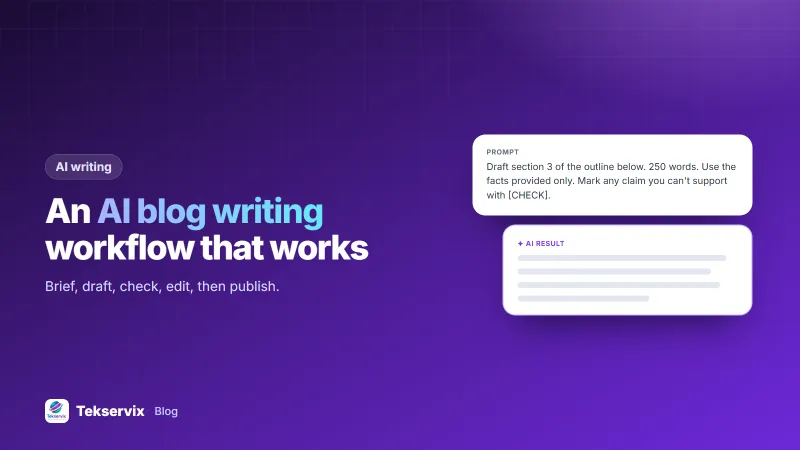
Asking for a whole article at once produces a vague, evenly spread text. Drafting one section at a time, with the brief and outline attached, gives tighter results. Useful instructions:
- "Use only the facts in the brief. Mark anything you'd need to check with [CHECK]."
- "Short paragraphs, two or three sentences. Concrete examples over general statements."
- "Write for a reader on a phone."
The AI writer in Tekservix AI text tools can produce blog drafts by topic, tone, keywords, audience and length as a starting point; treat whatever it produces as raw material.
5. Add what only you know#
This step decides whether the article ranks and gets shared. Go through the draft and add:
- Real prices, timelines and numbers from your business.
- A mistake you've seen customers make, and how to avoid it.
- An example from a typical job, described honestly. If it's illustrative rather than real, say so ("Imagine a shop that...").
- Your opinion where the topic has trade-offs.
Google's guidance on creating helpful, people-first content asks whether content shows first-hand experience. This is where yours comes from.
6. Check every fact#
AI drafts contain confident errors: outdated prices, wrong dates, features that don't exist, studies that were never published. Check every [CHECK] mark and every number, name and claim against a primary source. Link to the sources you used; outbound links to official pages build trust with readers.
7. Edit for voice#
Read the draft aloud. Cut the phrases that sound like a template, vary sentence length, and replace abstract words with concrete ones. Our guide to making AI writing sound human lists nine specific edits. The AI Humanizer can help rework stiff passages, but the final read should be yours.
8. Check originality and detection worries#
Run a plagiarism check to make sure no passage closely matches a published page; the checker in Tekservix SEO tools searches for distinctive sentences online. Don't chase a perfect "human" score on AI detectors. Our article on how accurate AI detectors are explains why they're unreliable. Focus on usefulness instead.
9. Publish with care#
- Write a specific title and meta description.
- Link to two or three of your related articles, and from them back to the new one.
- Add a clear next step: a tool, a quote form or a related guide.
- Publish at a steady, sustainable pace. A few strong articles a week beat dozens of thin ones.
Our SEO audit checklist covers the on-page details.
10. Update what you publish#
Set a reminder to review each article every six to twelve months. Prices change, tools change, and new questions appear. Updating a page that already ranks is often worth more than writing a new one.
A worked example#
Imagine [Company name], a small accounting firm that wants to write about VAT registration. Rather than asking an AI for "an article about VAT", the owner writes a brief with the five questions clients ask most, the firm's actual process and fees, two official sources, and a sample of their writing. The AI produces an outline; the owner removes a generic history section and adds "The three mistakes we fix most often". Each section is drafted separately, then the owner adds real timelines from recent registrations and checks every figure against the official guidance. The final article takes two hours, reads like the firm wrote it, and becomes the page clients are sent before their first meeting.
Frequently asked questions
Does Google penalise AI-written blog posts?
Google says it rewards helpful content however it's produced, and targets content made mainly to manipulate rankings, especially at scale. AI-assisted articles that are accurate, original and genuinely useful can rank. Mass-produced thin articles can fall under its spam policies, whether written by people or AI.
How long does it take to write a blog post with AI?
A good AI-assisted article usually takes one to three hours: time for the brief, reviewing the outline, editing each section, checking facts and adding your own examples. If it takes ten minutes, it probably reads like it, and won't stand out from what already ranks.
What should AI not write in a blog post?
Facts you haven't checked, statistics without a source, quotes, case studies and personal experiences. AI can't know what happened in your business, so real examples, prices, lessons and opinions must come from you.

Tekservix Team
The team behind Tekservix
The Tekservix Team builds and supports Tekservix: WhatsApp and SMS APIs, AI tools, invoicing, PDF and SEO tools for growing businesses. We write practical, tested guides based on what we see our customers do every day.
More articles from the Tekservix Team