Estimate vs Quote: What's the Difference and Which Should You Send?
Estimates and quotes both tell a customer what a job will cost, but they make very different promises. Here's the difference between an estimate and a quote, what each should include, and how to choose the right one for your job.
On this page
- The short answer
- When to send an estimate
- When to send a quote
- What an estimate should include
- What a quote should include
- A side-by-side example
- Pricing mistakes to avoid
- Handling changes after acceptance
- What about bids, proposals and pro forma invoices?
- From accepted quote to invoice
- A simple rule of thumb
A customer asks, "How much will it cost?" You could send an estimate or a quote. Many people use the words interchangeably, but they make different promises, and mixing them up is a common cause of disputes at the end of a job.
Here's the estimate vs quote question answered properly: what each document promises, what to include in each, and a simple way to decide which one to send.
The short answer#
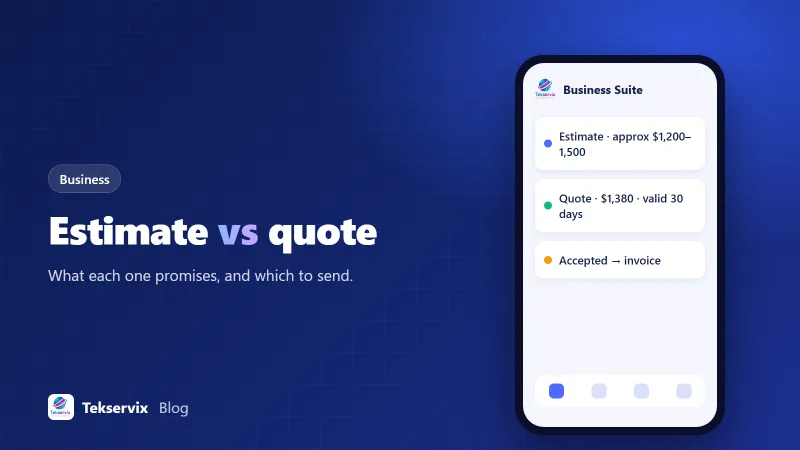
An estimate is an educated guess. It says roughly what the job should cost, based on what you know now, and it's understood that the final price may differ.
A quote (or quotation) is a fixed price for a defined piece of work. Once the customer accepts it, you're generally expected to do that work for that price, unless the scope changes.
Think of an estimate as "about this much" and a quote as "exactly this much, for exactly this".
A quick note: rules about how binding each document is vary by country and by industry, and some places have specific consumer protections. This article explains common practice; check local rules for your trade.
When to send an estimate#
Estimates make sense when you can't know the full scope until you start.
- A repair where you won't know what's wrong until you open it up.
- Software or design work where requirements are still loose.
- Early conversations when a customer just wants a ballpark to decide whether to go ahead.
- Jobs priced by time where hours are hard to predict.
A good estimate gives a range ("$1,200 to $1,500") or a figure with clear assumptions, and says what would push it up or down.
When to send a quote#
Quotes make sense when the work is well defined.
- A product or package with a known price.
- A job you've done many times, where materials and time are predictable.
- Any situation where the customer needs a firm number to approve a budget or purchase order.
- Competitive bids, where customers compare fixed prices.
Customers generally prefer quotes, because they remove uncertainty. The trade-off is that you carry the risk if the job takes longer than planned. Price that risk in, rather than hoping it won't happen.
What an estimate should include#
- Your business details and the customer's.
- A clear title: "Estimate", not "Quote".
- Description of the work as currently understood.
- The estimated price or range, with a breakdown if helpful (labour, materials).
- Assumptions: "Assumes existing wiring is in good condition."
- What could change the price and how you'll handle it: "We'll confirm with you before any work that would exceed the upper figure."
- Date issued.
What a quote should include#
- Your business details and the customer's.
- A unique quote number and date.
- A clear scope: what's included, line by line.
- Exclusions: what's not included. This is the part most often left out, and the part that prevents arguments.
- Price per line, subtotal, tax and total.
- Validity period: "This quote is valid for 30 days."
- Payment terms: deposit, milestones and final payment, plus accepted payment methods.
- Timeline or start date if relevant.
- How to accept: sign and return, reply by email or pay the deposit.
For bigger jobs, attach or reference your terms and conditions. Our guide to invoice payment terms covers wording for deposits and due dates that also works well on quotes.
A side-by-side example#
Picture a decorator asked to repaint a living room. After a quick look, they send an estimate: "$900 to $1,200, depending on the condition of the walls once the old wallpaper is off. If repairs push it above $1,200, we'll call you before going ahead." The customer knows the likely cost and what could change it.
A week later the decorator has stripped one wall, seen the plaster, and can now commit. They send a quote: "Prepare and paint living room walls and ceiling, two coats, customer's chosen colour, $1,080 including materials. Excludes woodwork and any plaster replacement. Valid 30 days. 30% deposit to book." Same job, but now the price and the scope are fixed in writing.
Lots of trades work exactly this way: an estimate early to see if the customer is interested, then a quote once the details are known. Labelling each document correctly is what keeps both sides clear on which stage they're at.
Pricing mistakes to avoid#
- Sending a quote without exclusions, then arguing about what "paint the room" included.
- Calling a document an estimate but writing a single exact figure with no assumptions, which customers will read as a quote anyway.
- Forgetting tax, delivery or call-out fees until the invoice.
- Leaving quotes open-ended, so a customer accepts a six-month-old price after your costs have gone up.
- Not following up. A short message a few days after sending ("Any questions about the quote?") wins more jobs than you'd expect.
Handling changes after acceptance#
Scope changes are normal. The customer asks for an extra room to be painted, or a feature added. The mistake is doing the extra work on a verbal "yes" and adding it to the final invoice as a surprise.
Instead, send a short revised quote or change order for the extra work, get it accepted, then do it. It takes five minutes and keeps the final invoice uncontroversial.
What about bids, proposals and pro forma invoices?#
- Bid or tender: a quote submitted in a competitive process, often to a formal specification.
- Proposal: a longer document explaining your approach, team and pricing, common in consulting and agency work. It usually contains a quote.
- Pro forma invoice: a preliminary invoice sent before goods are delivered, often for customs or prepayment. It looks like an invoice but isn't a demand for payment in the same way. Our explainer on the pro forma invoice goes into detail.
From accepted quote to invoice#
When the work is done, the invoice should match the accepted quote plus any approved changes, minus any deposit already paid. If you create quotes and invoices in the same system, you can convert one into the other without retyping, which avoids mismatched line items and numbers.
The Tekservix business suite lets you create branded quotes and invoices, track which have been accepted or paid, and turn a quote into an invoice in one click. If you only need a one-off invoice, the free invoice generator does the job without an account.
A simple rule of thumb#
If you'd be comfortable committing to the number, send a quote. If you genuinely can't know yet, send an estimate with clear assumptions and a promise to check in before going over. Either way, label the document correctly and write down what's included. Most pricing disputes come not from the number but from different ideas of what the number covered.
Frequently asked questions
Is an estimate legally binding?
Generally an estimate is understood as an approximate price, not a fixed one, though rules differ by country and some places limit how far a final bill can exceed an estimate without the customer's agreement. A quote is usually treated as a firm offer once accepted.
Can the price change after a quote is accepted?
Only if the work changes. If the customer asks for extra work, or the quote clearly excluded something that turns out to be needed, agree the change in writing and issue a revised quote or change order before doing the work.
How long should a quote be valid for?
Commonly 14 to 30 days, or shorter if your material costs move quickly. State the validity period clearly on the quote so you're not held to old prices months later.

Tekservix Team
The team behind Tekservix
The Tekservix Team builds and supports Tekservix: WhatsApp and SMS APIs, AI tools, invoicing, PDF and SEO tools for growing businesses. We write practical, tested guides based on what we see our customers do every day.
More articles from the Tekservix Team