How to Set Your Freelance Hourly Rate (Without Undercharging)
Most new freelancers take their old salary, divide by 40 hours and end up working for less than they earned as an employee. Here's a step-by-step way to calculate a freelance hourly rate that actually pays you.
On this page
- Step 1: decide what you want to take home
- Step 2: add your business costs
- Step 3: account for tax and benefits
- Step 4: work out your real billable hours
- Step 5: do the sum
- Step 6: check it against the market
- Hourly, daily or per project?
- Talking about your rate
- Common mistakes
- Get paid for the hours you bill
Here's a calculation almost every new freelancer does. "I earned $50,000 a year in my job. That's about $25 an hour. So I'll charge $25 an hour." It feels fair and it's badly wrong. Six months later they're busy, tired and somehow earning less than before.
The problem is that an employee's hourly figure hides a lot of things an employer paid for: holidays, sick days, equipment, software, pension contributions, the hours spent in meetings that weren't "work". As a freelancer, you pay for all of that yourself, out of the hours you can actually bill. This guide walks through a freelance hourly rate you can live on.
Step 1: decide what you want to take home#
Start with the yearly income you want for yourself, before tax. Be honest. If you were earning $50,000 as an employee, that's a reasonable floor, not a ceiling, because freelancing carries more risk.
Step 2: add your business costs#
List everything the business pays for in a year:
- Laptop, phone and other equipment (spread over their useful life).
- Software subscriptions, hosting, domain, design tools.
- Internet and a share of home office costs, or a co-working desk.
- Insurance, accounting, bank fees and payment processing fees.
- Training, books and conferences.
- Marketing: website, portfolio, the occasional ad.
For many solo freelancers this lands somewhere between a few thousand and ten thousand dollars a year. Use your own figures.
Step 3: account for tax and benefits#
Depending on your country, you'll pay income tax and probably some form of self-employment or social contributions that an employer used to share. You may also need to fund your own pension and health cover. The rules vary so much by country that a quick conversation with a local accountant is worth it. For a first estimate, add a sensible percentage on top of your income target.
Step 4: work out your real billable hours#
This is where most rates go wrong. A year has about 52 working weeks, but you won't bill all of them.
- Take off holidays, public holidays and a few sick days. Say 6 to 8 weeks.
- That leaves roughly 44 to 46 working weeks.
- Of a 40-hour week, a lot goes to unpaid work: finding clients, writing proposals, invoicing, admin, learning. For many freelancers, only 50% to 70% of working time is billable.
So 45 weeks at 25 billable hours a week gives 1,125 hours a year, not the 2,080 of a full-time job. That single number explains why freelance rates look high to people who've never freelanced.
Step 5: do the sum#
Add income, costs and tax, then divide by billable hours.
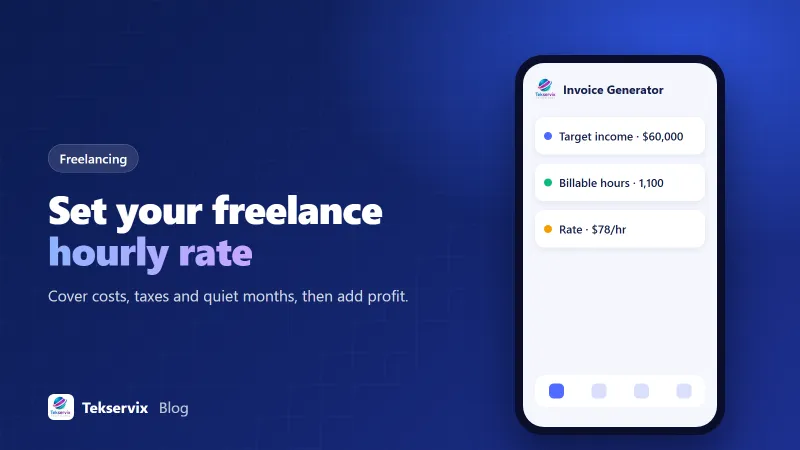
A worked example: $60,000 income target, $6,000 business costs and $20,000 for tax and contributions gives $86,000. Divide by 1,100 billable hours and you get about $78 an hour. That's the minimum rate at which the business works. Charging $25 an hour, as in the opening example, would have paid less than a third of it.
Add a margin on top for profit and for quiet months. Freelance income is lumpy: a client pauses, a project slips, December goes quiet. A buffer of 10% to 20% keeps those months from turning into panic.
Step 6: check it against the market#
Your calculated rate is your floor. The market tells you the ceiling. Look at rates on freelance platforms for people with similar skills and experience, ask peers in communities for your field, and read any rate surveys your industry publishes. Keep in mind that platform rates are often lower than direct-client rates because of competition and fees.
If the market pays much less than your floor, you have three options: specialise in a niche that pays more, target bigger clients, or lower your costs. Cutting your rate below the floor isn't a real option. It just delays the problem.
Hourly, daily or per project?#
An hourly rate is a useful number even if you never quote it. It lets you price other ways:
- Day rate: common in consulting and creative work. Clients find it simpler, and it protects you from being billed in 15-minute fragments.
- Project fee: estimate the hours, multiply by your rate, add a buffer for revisions and unknowns, and quote a fixed price. If you get faster, you keep the benefit.
- Retainer: a fixed monthly fee for a set amount of availability or output. Great for steady income.
Our article on estimates vs quotes covers how to present a project price so it doesn't turn into an argument later.
Talking about your rate#
State your rate plainly, without apology. "My rate is $80 an hour, and I estimate this at 20 to 25 hours" is confident and clear. If a client pushes back, change the scope, not the rate: "For that budget, I can do the homepage and two inner pages rather than all five." Clients respect that more than a discount, and it stops you training them to haggle.
When you raise rates, give existing clients notice, often 30 to 60 days, and a short reason, like expanded experience or rising costs. Apply new rates to new clients immediately.
Common mistakes#
- Basing the rate on an old salary divided by 2,080 hours.
- Forgetting that unpaid admin and sales take a third or more of the week.
- Pricing by what feels comfortable to say rather than what the business needs.
- Never raising rates, so experience doesn't show up in income.
- Giving discounts at the first sign of hesitation.
- Not putting payment terms in writing. A good rate means nothing if invoices are paid 90 days late.
Get paid for the hours you bill#
Once your rate is set, make billing painless. Track hours as you go, invoice promptly, and state clear terms. Our guides to freelance invoices and invoice payment terms cover what to include. The free Tekservix invoice generator has 108 templates: add your logo, hours and rate, then download a PDF or send your client a private link. If you're doing it every month, the business suite keeps clients, quotes and invoices in one place.
Run the six steps above with your own numbers tonight. If the result surprises you, that's normal. Most freelancers find their real minimum rate is well above what they've been charging, and knowing the number is the first step to fixing it.
Frequently asked questions
How do I calculate my freelance hourly rate?
Add up the income you want plus your business costs, taxes and savings for holidays and quiet months. Divide that by the hours you can realistically bill in a year, which is usually far fewer than you work. Then check the result against what clients in your field pay.
Should freelancers charge hourly or per project?
Hourly suits work with an unclear scope or ongoing support. Project pricing suits well-defined jobs and rewards you for getting faster. Many freelancers use an hourly rate internally to price projects, then quote a fixed fee.
How often should I raise my freelance rates?
Review them at least once a year, and whenever you're consistently fully booked. Give existing clients notice, often 30 to 60 days, and apply new rates to new clients straight away.

Tekservix Team
The team behind Tekservix
The Tekservix Team builds and supports Tekservix: WhatsApp and SMS APIs, AI tools, invoicing, PDF and SEO tools for growing businesses. We write practical, tested guides based on what we see our customers do every day.
More articles from the Tekservix Team