Price Optimization for Businesses: Find Prices That Earn More
Practical price optimization for businesses: why small price changes matter, knowing your true costs, reading demand, testing prices safely, bundles and tiers, discounts that don't destroy margin, and using tools to model options.
On this page
Most businesses set prices once, based on a quick look at costs and competitors, and then leave them alone for years while costs creep up. That's expensive. Price is usually the most powerful profit lever a business has, because a price change affects every single sale. Price optimization doesn't need an economist or complex software. It needs clear costs, some attention to how customers respond, and the habit of testing small changes.
Why small price changes matter so much#
Imagine a product that sells for C$5 costs C$3.50 to make and deliver, and so earns C$1.50. Raise the price by 5%, to C$5.25 and profit per sale rises to C$1.75: a 17% increase in profit from a 5% price change. That's why pricing research has long shown price to be one of the strongest drivers of profit; the Harvard Business Review's classic article "Managing Price, Gaining Profit" makes the case in detail. The reverse is also true: a 5% discount on the same product cuts profit per sale by 17%.
Step 1: Know your true cost#
You can't optimize a price without knowing what each sale really costs. Include:
- Materials or stock cost.
- Packaging.
- Delivery or transport.
- Payment fees, such as card or digital wallet charges.
- A share of fixed costs: rent, salaries, utilities.
- Waste, breakage or returns.
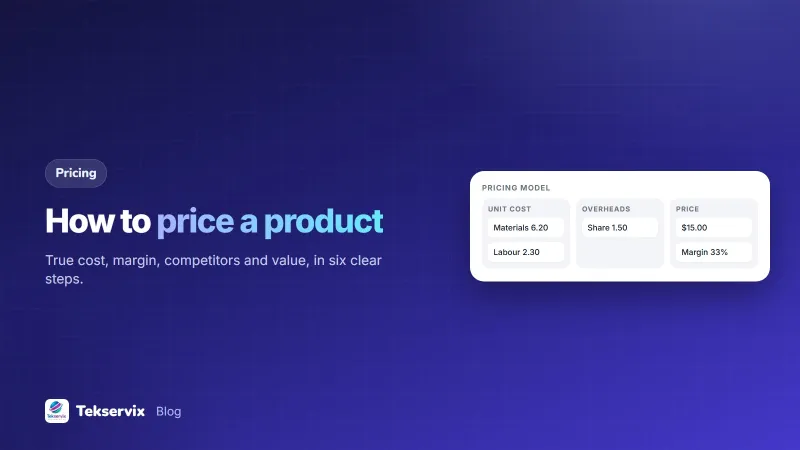
Many businesses discover their "profitable" product barely breaks even once delivery and payment fees are counted. Our guide on how to price a product walks through working out unit cost.
Step 2: Understand what customers value#
Customers don't pay for your costs; they pay for what the product does for them. Ask:
- Which customers buy most, and why do they choose you?
- What would they do if you didn't exist: buy elsewhere, make it themselves, go without?
- What extras do they value: speed, quality, reliability, convenience, service?
- Where do customers never mention price? That's often where you're underpriced.
Step 3: Check the market, don't copy it#
Look at what competitors charge for comparable products, but remember they may have different costs, quality and customers. Being the cheapest is a strategy that only works if you have the lowest costs. Many businesses do better being slightly more expensive and clearly better in one way that matters to customers.
Step 4: Model your options#
Before changing anything, estimate what happens at a few price points. For each option, estimate how many you'd sell and calculate total profit, not just revenue:
| Price | Profit per unit | Estimated units | Total profit |
|---|---|---|---|
| C$4.50 | C$1 | 220 | C$220 |
| C$5 | C$1.50 | 205 | C$307.50 |
| C$5.50 | C$2 | 160 | C$320 |
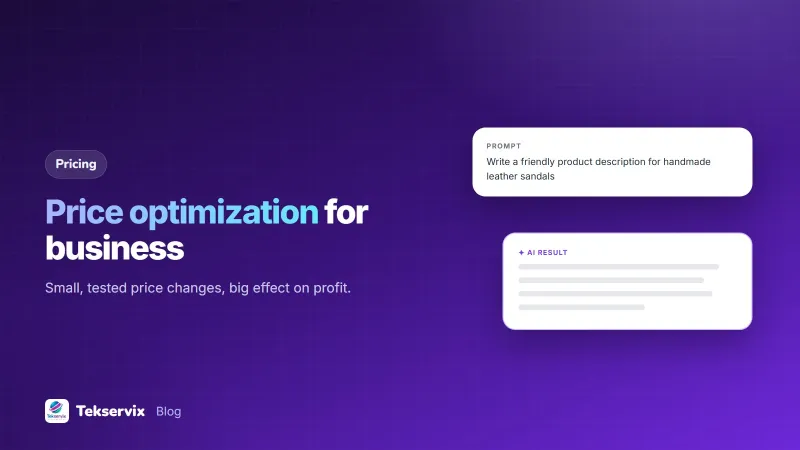
Notice that the lowest price sells the most but earns the least. The Tekservix price optimizer helps with this step: enter your costs and competitor prices, and it models margins and demand at different prices and recommends a price range, with the margins explained.
Step 5: Test safely#
Estimates are guesses until customers respond. Test in ways that limit risk:
- One product at a time, starting with a good seller where you suspect you're underpriced.
- Small steps, such as 5 to 10%, rather than big jumps.
- For a few weeks, long enough to smooth out random busy and quiet days.
- Compare like with like: the same weeks last year, or a similar product whose price you didn't change.
Track units sold and total profit. If profit rises and sales dip only slightly, keep the new price.
Step 6: Use structure, not just numbers#
- Tiers: a basic, standard and premium version let customers choose, and many choose the middle.
- Bundles: combine items that go together at a slightly lower total price, which raises the average sale.
- Minimum orders for delivery, or a delivery fee, so small orders don't lose money.
- Deposits or prepayment discounts for custom work, which improve cash flow.
Discounts: use them deliberately#
Discounts are the fastest way to lose margin. Before running one, calculate how many extra sales you'd need just to earn the same profit. A 10% discount on a product with a 30% margin needs roughly 50% more sales to break even. Use discounts for a purpose, such as clearing old stock, winning back lapsed customers or launching a product, with a clear end date, not as a habit.
Keep reviewing#
Check prices at least twice a year and whenever costs change. Look at your profit and loss statement for margins that are shrinking; our guide to the profit and loss statement shows what to watch. Data from your sales, analysed with tools like the ones in our guide to analysing data with AI, can show which products are underpriced or overpriced.
A worked example#
Imagine a small bakery whose most popular cake sells for C$5. A cost review shows ingredients, packaging, payment fees and a share of rent come to C$3.50 not the C$3 the owner assumed. Competitors charge between C$5 and C$6.50 and customers often praise the cake's quality. The bakery raises the price to C$5.50 for four weeks and watches sales. Units drop slightly, from about 205 to 190 a month, but monthly profit on the cake rises from about C$307.50 to C$380 nearly a quarter more. The owner keeps the new price, adds a "cake plus six cupcakes" bundle, and schedules the next review for six months later.
Frequently asked questions
What is price optimization?
Price optimization is choosing prices that balance profit and sales volume, based on your costs, what customers are willing to pay and what competitors charge, then testing and adjusting over time rather than setting a price once and forgetting it.
How often should a business review prices?
At least twice a year, and whenever costs change significantly, such as a supplier price rise or a new tax. Review your best-selling products first, because small changes there have the biggest effect.
Will raising prices lose me customers?
Some price-sensitive customers may leave, but a modest rise often increases profit even with slightly fewer sales. Test on a few products, explain changes clearly, and watch sales for a few weeks before deciding.

Tekservix Team
The team behind Tekservix
The Tekservix Team builds and supports Tekservix: WhatsApp and SMS APIs, AI tools, invoicing, PDF and SEO tools for growing businesses. We write practical, tested guides based on what we see our customers do every day.
More articles from the Tekservix Team