Facebook Page vs Group: Which One Your Business Actually Needs
Facebook pages and groups look similar but work very differently. Here's a plain comparison of Facebook page vs group for business: reach, ads, moderation and effort, and when it makes sense to run both.
On this page
- The short answer
- What a Facebook page does well
- What a Facebook group does well
- Side by side
- What about a personal profile?
- Reach is earned, not owed
- Businesses that should start a group
- Running both: how they connect
- How to run a group that doesn't die
- Keeping your page active
- Measuring whether it's working
- Our recommendation
A business owner asks us this every few weeks: "Should we have a Facebook page or a group?" The question makes sense. Both have a cover photo, posts and members of the public. But they're built for different jobs, and picking the wrong one means a lot of effort for little return.
Here's a plain comparison of Facebook page vs group: what each is for, how reach and ads work, how much effort each takes, and when it's worth running both.
The short answer#
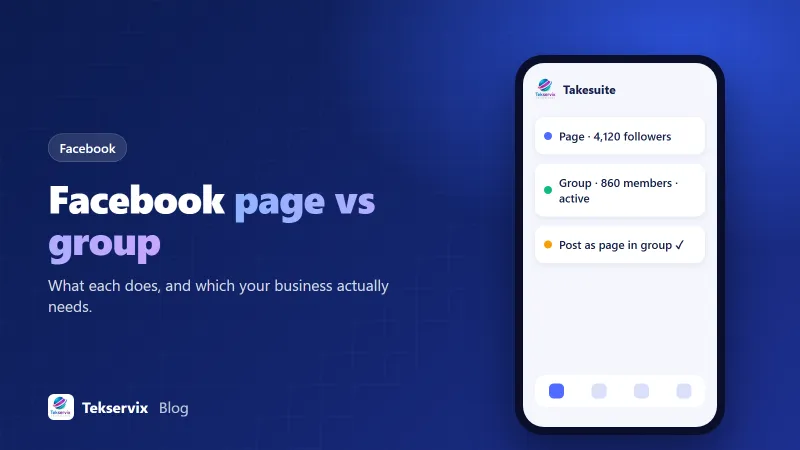
A page is your business's official presence: a storefront, a noticeboard and the base for advertising. A group is a community space where members talk to each other, with you as host. Almost every business needs a page. Only some benefit from a group, and only if someone will look after it.
What a Facebook page does well#
- It's your official profile: hours, address, phone, website, reviews and services.
- It shows up when people search for your business on Facebook and often on Google.
- It's where ads run from. You can't advertise from a group.
- It has insights about your audience and posts.
- Customers can message you, book appointments or shop, depending on the features you enable.
The weakness is organic reach. Posts from pages often reach a small share of followers unless people engage with them, which is why many businesses combine page posts with ads or other channels.
What a Facebook group does well#
- Members talk to each other, not just to you. That's the whole point.
- Posts in active groups tend to get more comments and conversation than page posts.
- Members often get notifications about new posts, depending on their settings.
- Private groups create a sense of belonging, which suits loyal customers, members or students.
- You learn what customers actually think, ask and struggle with, in their own words.
The weakness is effort. A group with no host turns into either silence or spam. Someone has to approve members, start conversations, answer questions and remove rule-breakers.
Side by side#
- Purpose: page = official presence; group = community discussion.
- Who posts: page = mostly you; group = members and you.
- Ads: page = yes; group = no.
- Discoverability: page = high, searchable as a business; group = lower, depends on privacy settings.
- Effort: page = steady posting; group = daily moderation and conversation.
- Insights: both have them, pages more detailed for business use.
What about a personal profile?#
Some small business owners run their business from a personal Facebook profile. Don't. Facebook's terms expect businesses to use pages, you can't run ads or see business insights from a profile, and mixing family photos with sales posts serves nobody. Use your personal profile to share your page's posts and to join groups as yourself, which is genuinely useful, but keep the business on a page.
Reach is earned, not owed#
A common frustration: "We have 3,000 followers and our posts reach 90 people." That's normal. Facebook shows page posts to the followers most likely to engage, and tests them with a small group first. Posts that get comments, shares and saves early are shown more widely. Posts that get ignored stop there.
Groups follow similar logic. A big but quiet group reaches few people. A small group where members reply to each other reaches nearly everyone. Size is vanity in both cases. Conversation is what spreads.
Businesses that should start a group#
Groups work best when customers have a reason to talk to each other, not just to you. Good examples:
- A gym or running club where members share progress and arrange workouts.
- A software company with users who swap tips and templates.
- A course creator or coach running a cohort of students.
- A craft supplies shop whose customers share projects.
- A local business building a neighbourhood community around a shared interest.
Businesses where customers buy once and move on, like a plumber or a dentist, usually get little from a group. A well-kept page and good reviews serve them better.
Running both: how they connect#
If you do run a group, link it to your page. You can then post and comment in the group as your page, show the group on your page, and keep a consistent brand. A common setup:
- The page handles announcements, offers, ads and customer messages.
- The group is for members: questions, discussion, early access and community events.
- Page posts occasionally invite people to join the group, and group members are pointed to the page for official news.
How to run a group that doesn't die#
- Write three to five clear rules, pinned at the top. No spam, be kind, stay on topic, and whatever matters for your community.
- Use membership questions to keep bots and spammers out.
- Post a weekly prompt: a question, a challenge, a "share your work" thread.
- Answer questions quickly in the early weeks, until members start answering each other.
- Invite your best customers first. Ten engaged members beat 500 silent ones.
- Don't sell in every post. If the group feels like an advert, people leave.
Keeping your page active#
A page doesn't need daily posts, but it needs to look alive. Two to four posts a week, answered messages and up-to-date hours are enough for most businesses. Planning posts in advance makes consistency much easier; Takesuite lets a team plan a month of posts on a calendar, get them approved and schedule them. Our guide to building a content calendar has a simple template.
Measuring whether it's working#
For a page, watch messages received, website clicks and how many people engage with posts, not just follower counts. For a group, watch active members (people who post, comment or react each week), the share of posts started by members rather than you, and questions answered by other members. When members start answering each other, the group has become a community, which is the whole goal.
Our recommendation#
Start with a page and do it properly: complete profile, regular posts, quick replies to messages, and a reason for customers to follow. Add a group only when you have customers who'd genuinely enjoy talking to each other and someone who can host it most days. A thriving group is one of the best assets a business can build on Facebook. An abandoned one is a small, public sign that nobody's home.
Frequently asked questions
Can a business run ads from a Facebook group?
No. Facebook ads run from a page. Groups can be linked to a page, and you can post in a group as your page, but advertising, page insights and most business tools require a page.
Do posts in groups reach more people than page posts?
Often, among members. Group posts can appear in members' feeds and notifications, and active groups usually see more conversation than page posts. But reach depends on how engaged the group is, not just its size.
Is a private group better than a public one for a business?
Private groups feel more exclusive and encourage honest discussion, which suits customer communities and paid members. Public groups are easier to discover. Many businesses choose private with membership questions to keep spam out.

Tekservix Team
The team behind Tekservix
The Tekservix Team builds and supports Tekservix: WhatsApp and SMS APIs, AI tools, invoicing, PDF and SEO tools for growing businesses. We write practical, tested guides based on what we see our customers do every day.
More articles from the Tekservix Team