Invoice vs Bill: What's the Difference (and Does It Matter)?
People use 'invoice' and 'bill' interchangeably, and most of the time that's fine. But in accounting the words point to different sides of the same transaction. Here's the difference, with examples, and when it actually matters.
On this page
- Same document, two perspectives
- How accounting treats each
- Invoices: accounts receivable
- Bills: accounts payable
- When "bill" means something different
- When "invoice" carries specific weight
- Related documents people confuse
- A worked example: one sale, two sets of books
- Does the word you use matter?
- Keeping both sides organised
A client emails: "Can you send me the bill?" Your accountant asks you to "enter your bills". Your software has one tab called Invoices and another called Bills. It's natural to wonder whether these are two different things, and whether you've been using the wrong word for years.
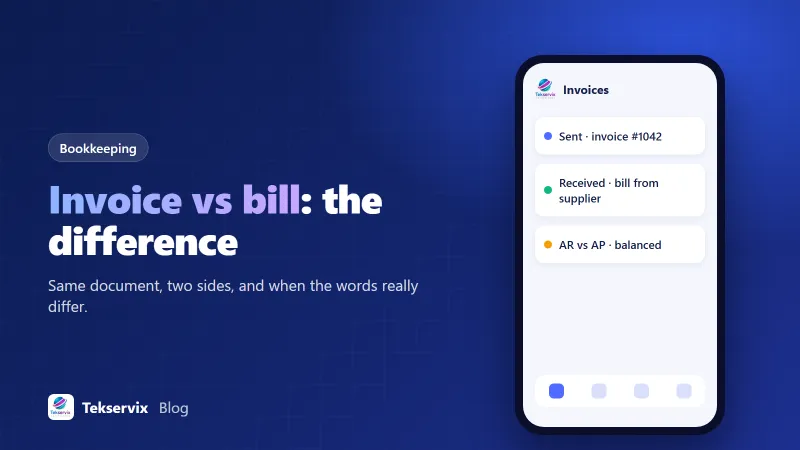
Here's the short answer to invoice vs bill: very often they're the same piece of paper, seen from opposite sides of the transaction. The seller calls it an invoice; the buyer treats it as a bill. But there are a few situations where the words really do mean different things, and they're worth knowing.
Same document, two perspectives#
Imagine a design agency finishes a logo project for a bakery. The agency creates a document listing the work, the price, the due date and how to pay. From the agency's point of view, that's an invoice: a request for payment it has issued.
The bakery receives the same document. From its point of view, it's a bill: something it owes and needs to pay. Nothing about the paper changed. Only the perspective did.
That's why accounting software separates them. Invoices are documents you send; bills are documents you receive.
How accounting treats each#
Invoices: accounts receivable#
When you send an invoice, your bookkeeping records money owed to you, known as accounts receivable. Until the client pays, it sits there as an asset: money you've earned but not yet received. When payment arrives, the receivable is cleared.
Bills: accounts payable#
When you receive a bill from a supplier, you record money you owe, known as accounts payable. It's a liability until you pay it. Entering bills when they arrive, rather than when you pay them, gives you a true picture of what you owe at any moment.
Keeping both sides up to date is how you know your real cash position. A business can look comfortable on its bank balance while owing a lot in unpaid bills, or look tight while clients owe it a fortune.
When "bill" means something different#
In everyday life, "bill" often refers to documents that aren't business invoices in the usual sense:
- Restaurant bills: in British English you ask for the bill at the end of a meal (in American English, the check). It's a request for immediate payment, usually without formal invoice details.
- Utility bills: electricity, water, phone and internet. These are invoices from the provider, but everyone calls them bills.
- Medical bills: statements of charges from healthcare providers.
In these cases, nobody would call the document an invoice in conversation, even though technically it does the same job.
When "invoice" carries specific weight#
In business and tax contexts, "invoice" often has a precise meaning. Many countries define what a valid tax or VAT invoice must contain: the supplier's tax number, a unique invoice number, the date, the customer's details, a description of the goods or services, amounts and tax. A document missing these may not let your customer reclaim tax, even if it says "bill" or "invoice" at the top. Our guide to VAT invoice requirements lists the usual elements.
So when you're the seller, call your document an invoice and make sure it meets the rules where you operate.
Related documents people confuse#
- Quote or estimate: a price offered before work is agreed. Not a request for payment.
- Pro forma invoice: a preliminary invoice sent before delivery, often for customs or advance payment. Our pro forma invoice guide explains when it's used.
- Receipt: proof that payment was made, issued after the money arrives. We compared them in invoice vs receipt.
- Statement: a summary of several invoices and payments over a period, showing the balance outstanding.
- Bill of sale: a legal document transferring ownership of an item, like a car. Despite the name, it's not a bill in the payment sense.
- Credit note: a document reducing what a customer owes, for example after a return.
A worked example: one sale, two sets of books#
Here's one transaction recorded on both sides. On 3 November, a print shop delivers 500 brochures to a dental practice and issues invoice PS-2026-118 for $650, due in 14 days.
- The print shop records $650 in accounts receivable and $650 in sales.
- The dental practice records $650 in accounts payable and $650 in marketing expenses.
On 15 November, the practice pays. The print shop moves $650 from receivables into its bank balance. The practice reduces its payables and its bank balance by the same amount. One document, two mirror-image entries. If either side forgets to record its part, its picture of cash flow is wrong until someone notices.
That mirror image is also why it helps to include the customer's reference (like a purchase order number) on your invoice. It lets their accounts team match your invoice to their records quickly, which is usually what speeds up payment.
Does the word you use matter?#
In conversation with clients, not much. If a client asks for the bill, send your invoice and nobody will mind. In your own bookkeeping, it matters more, because recording an invoice you sent as a bill you owe (or the reverse) flips your numbers. And in formal or tax contexts, using a document that meets invoice requirements matters a lot.
A good rule of thumb: when you're asking to be paid, it's an invoice. When someone is asking you to pay, it's a bill. Simple, and it covers nearly every case you'll meet.
Keeping both sides organised#
For invoices you send, number them sequentially, include clear payment terms and due dates, and track which are paid. For bills you receive, file them as they arrive, note the due dates and schedule payments so you don't miss early-payment discounts or incur late fees.
For the sending side, the Tekservix invoice generator creates invoices with your details, terms and due dates and lets you download a PDF to send in a couple of minutes. If you're setting up the rest of your bookkeeping, our bookkeeping guide covers how invoices, bills and receipts fit together.
Frequently asked questions
Is an invoice the same as a bill?
Often it's the same document seen from different sides. The seller issues an invoice; the buyer receives it and records it as a bill to pay. In everyday speech, people use the words interchangeably.
Do I send an invoice or a bill to a client?
If you're the one being paid, you send an invoice. Calling it a bill isn't wrong in conversation, but 'invoice' is the standard term for a document requesting payment for goods or services between businesses.
What's the difference between accounts receivable and accounts payable?
Accounts receivable is money owed to you, tracked from the invoices you send. Accounts payable is money you owe, tracked from the bills you receive. Most accounting software has separate sections for each.

Tekservix Team
The team behind Tekservix
The Tekservix Team builds and supports Tekservix: WhatsApp and SMS APIs, AI tools, invoicing, PDF and SEO tools for growing businesses. We write practical, tested guides based on what we see our customers do every day.
More articles from the Tekservix Team