Commercial Invoice for Export: What to Include So Customs Doesn't Hold Your Shipment
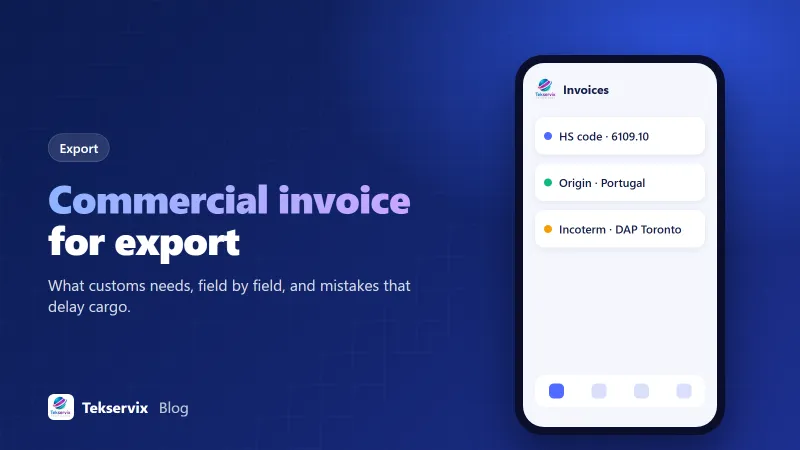
When goods cross a border, the commercial invoice is the document customs reads first. Missing details mean delays, extra duties or returned shipments. Here's what a commercial invoice needs, field by field, and the mistakes that hold up cargo.
On this page
- What a commercial invoice is for
- The essential fields
- Seller (exporter) and buyer (importer)
- Invoice number and date
- Detailed description of each item
- HS code
- Country of origin
- Quantity, unit price and total value
- Weights and packages
- Incoterms
- Reason for export
- Declaration and signature
- Helpful extras
- Common mistakes that delay shipments
- How many copies?
- Keep your documents consistent
- A note on duties and taxes
- Making it routine
A shipment of 400 cotton T-shirts sits in a customs warehouse for nine days. The goods are fine, the buyer has paid, the paperwork mostly exists. The problem is one document with a vague description ("clothing"), no HS code and a value that doesn't match the payment. That's the commercial invoice, and it's where most export delays begin.
When goods cross a border, customs uses the commercial invoice to decide what the goods are, what they're worth, where they come from and how much duty and tax is due. Get it right and shipments move. Get it wrong and you pay for storage, delays and sometimes penalties. Here's what to include, field by field.
What a commercial invoice is for#
A commercial invoice does two jobs at once. It's a bill from the seller to the buyer, and it's a customs declaration of the goods' description and value. Customs authorities in both the exporting and importing countries may rely on it. Couriers like DHL, FedEx and UPS require one for most international parcels, and freight forwarders need it for larger shipments.
It's different from a pro forma invoice, which is a preliminary document sent before the sale is final, often so the buyer can arrange payment or an import licence. Our pro forma invoice guide explains when that's used.
The essential fields#
Seller (exporter) and buyer (importer)#
Full legal names, addresses, phone numbers and email addresses. Include tax or VAT numbers and any customs registration numbers, such as an EORI number for businesses trading with the EU or UK. If the goods are going to a different address than the buyer's (the consignee), list that too.
Invoice number and date#
A unique number and the date of issue, consistent with your accounting records.
Detailed description of each item#
This is where vague invoices fail. "Parts" or "clothing" isn't enough. Describe what each item is, what it's made of and what it's for: "Men's T-shirts, 100% cotton, knitted, short sleeve". Customs officers should be able to classify the goods from your description alone.
HS code#
The Harmonized System code classifies goods for customs and determines the duty rate. The first six digits are international; countries add more digits for their own tariffs. Look codes up in the destination country's tariff database or ask your forwarder. An incorrect code can mean the wrong duty, or a shipment held while customs reclassifies it.
Country of origin#
Where the goods were made, which isn't always where they ship from. Origin affects duty rates, especially where trade agreements apply, and some agreements require a separate certificate or origin statement to claim reduced duty.
Quantity, unit price and total value#
The number of units, the price per unit, the line total and the invoice total, in the currency of the transaction. The values should match what the buyer actually pays. Undervaluing to reduce the buyer's import duty is customs fraud in most countries, and it's easier to spot than people think.
Weights and packages#
Net and gross weight, the number of packages and, ideally, package dimensions. These should match the shipping label and packing list.
Incoterms#
The Incoterms rule, such as EXW, FCA, DAP or DDP, with a named place: "DAP Toronto". It defines who pays for transport, insurance and import duties, and where risk passes from seller to buyer. It also affects how customs values the goods.
Reason for export#
Sale, sample, repair and return, gift, or temporary export. Couriers ask for this, and it affects how customs treats the shipment.
Declaration and signature#
A statement that the information is true and correct, with the name, title and signature of the person responsible, and the date. Some couriers accept an electronic signature.
Helpful extras#
- Payment terms and method, such as "30% advance, 70% against bill of lading".
- The purchase order number from the buyer.
- Shipping details: carrier, tracking or bill of lading number, port of loading and discharge.
- Export licence numbers for controlled goods.
- Any certificates that accompany the goods, like a certificate of analysis or conformity for regulated products.
Manufacturers and traders often need those certificates too. Our guide to certificates of analysis explains what buyers and regulators expect.
Common mistakes that delay shipments#
- Vague descriptions that don't let customs classify the goods.
- Missing or wrong HS codes.
- Values that don't match the payment, or that look unrealistically low.
- Currency not stated, or different currencies on different documents.
- Weights and package counts that don't match the packing list or label.
- Country of origin missing, or confused with the country of shipment.
- Unsigned invoices, or too few copies for the carrier.
- Free samples declared at zero value with no explanation.
How many copies?#
Requirements vary by carrier and destination. Many couriers ask for three printed copies attached to the parcel in a document pouch, plus an electronic copy submitted with the shipment booking. Some countries require specific language or additional certification. Ask your carrier or forwarder before the first shipment to a new country, and keep a copy for your records.
Keep your documents consistent#
Customs compares the commercial invoice with the packing list, the shipping label, the bill of lading or air waybill, and any certificates. The same descriptions, quantities, weights and values should appear across all of them. Many delays come from small inconsistencies between documents prepared by different people at different times.
A note on duties and taxes#
The commercial invoice doesn't decide who pays import duty and tax; the Incoterms and your sales agreement do. But customs uses the invoice to calculate how much is due. If you sell to consumers abroad, decide whether you'll ship duties paid or unpaid, and tell the buyer clearly. Surprise import charges on delivery are a common cause of refused parcels and unhappy customers.
Making it routine#
Once you export regularly, build a standard product list with descriptions, HS codes, origins and unit weights, so every invoice uses the same verified details. The Tekservix invoice generator lets you save your business details and line items and download a clean PDF; add the customs fields in the item descriptions and notes, then check the final document against your carrier's requirements. The first export invoice takes the most care. After that, consistency does most of the work.
Frequently asked questions
What is the difference between a commercial invoice and a regular invoice?
A regular invoice requests payment. A commercial invoice also serves as a customs document, so it includes details customs authorities need: HS codes, country of origin, Incoterms, weights, and the reason for export. Many exporters use one document that does both jobs.
Who prepares the commercial invoice?
The exporter or seller, usually. Couriers and freight forwarders often provide a template and may help fill it in, but the exporter is responsible for the information being accurate.
Do I need a commercial invoice for samples or free goods?
Usually yes. Customs still needs to know what's in the shipment and its value. Mark it clearly, for example 'Free of charge sample, no commercial value', and state a realistic value for customs purposes.

Tekservix Team
The team behind Tekservix
The Tekservix Team builds and supports Tekservix: WhatsApp and SMS APIs, AI tools, invoicing, PDF and SEO tools for growing businesses. We write practical, tested guides based on what we see our customers do every day.
More articles from the Tekservix Team