Short Code vs Long Code SMS: Which Sender Type Fits Your Business?
Short code vs long code SMS explained: what each is, sender names, speed, cost, setup time, replies and trust, typical uses, and how to choose the right sender type for reminders, marketing and verification codes.
On this page
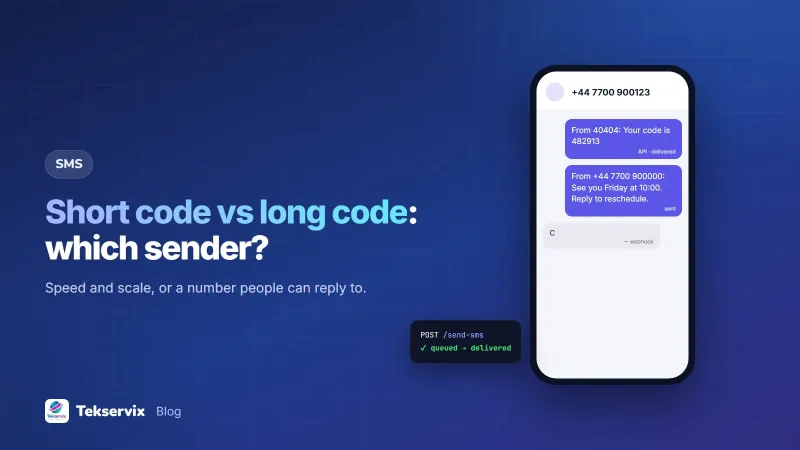
When a business sends a text, the recipient sees one of three things as the sender: a short number like 40404, a normal phone number, or a name like your business. Each comes with different costs, speeds, rules and abilities. Understanding short code vs long code SMS, and where sender names fit, helps you choose the right one for each kind of message instead of paying for capabilities you don't need.
The three sender types#
Short codes#
A short code is a 4 to 6 digit number built for high-volume business messaging. Businesses usually lease one per country through a provider, and it's approved by operators for a specific use. Short codes can send large volumes quickly and are easy to remember for "text JOIN to 40404" campaigns.
Long codes#
A long code is an ordinary full-length phone number, the kind people use every day. It supports two-way conversation naturally: customers can reply, and often call. Long codes suit lower volumes and personal, conversational messages. A phone-based gateway like SMS Gora sends from your own SIM, which is a long code.
Alphanumeric sender IDs#
A sender name made of letters, such as "BAKERY", shown instead of a number. It's great for recognition on one-way messages, but in most cases people can't reply, and many countries require registration before use.
Side by side#
| Short code | Long code | Sender name | |
|---|---|---|---|
| Looks like | 40404 | +44 7700 900000 | BAKERY |
| Volume and speed | Very high | Low to moderate | High, one-way |
| Replies | Yes, often keyword-based | Yes, natural conversation | Usually no |
| Setup | Weeks, with approval and a lease | Immediate with a SIM or number | Registration often required |
| Cost | Highest; lease plus messages | Lowest for local use | Per message |
| Recognition | Good for campaigns | Customers can save it | Brand name visible |
When a short code fits#
- National marketing campaigns with "text KEYWORD to 40404" calls to action.
- Very large volumes, such as verification codes for a big app or emergency alerts.
- Voting, competitions and TV or radio promotions that need an easy number.
Short codes come with rules. Operators and industry bodies set requirements for opt-in, HELP and STOP handling, and content; in the United States, for example, the CTIA Messaging Principles and Best Practices describe what's expected. The cost and approval time rarely make sense for a business.
When a long code fits#
- Appointment reminders where patients or clients reply to confirm or reschedule.
- Order and delivery updates where customers reply with questions.
- Customer service by text.
- Local businesses whose customers already know and save the number.
- Moderate campaigns sent at a sensible pace to opted-in customers.
Because it's a normal number, people are more likely to reply, and the conversation continues in the same thread. Pace matters: long codes, and especially SIM-based sending, aren't designed for thousands of messages a minute. Our guide to bulk SMS costs and rules covers realistic volumes for phone-based sending.
When a sender name fits#
- One-way notifications where brand recognition matters, such as "Your parcel has shipped".
- Bank and service alerts where recipients expect a name.
- Markets where people are used to seeing named senders from businesses.
Remember the trade-off: if a customer tries to reply to a sender name, the reply usually goes nowhere. Put a phone number or link in the message if you want a response.
Verification codes#
For login and verification codes, what matters most is fast, reliable delivery. Small apps with modest volumes often do fine with a long code or a phone gateway; very large apps usually use short codes or registered sender IDs through a carrier-connected provider for throughput. Whatever you use, protect the sending form against bots, which can run up costs quickly; our guide to SMS OTP verification covers the safeguards.
Trust and recognition#
Whatever sender you use, recipients need to know who's texting them. SMS scams are common, and a message from an unknown sender asking someone to click a link is exactly what people have learned to ignore. A few habits build trust across every sender type:
- Start every message with your business name, even when the sender is a name.
- Use the same sender consistently, so customers learn to recognise it.
- Tell customers which number you use on receipts, your website and in person, and invite them to save it.
- Avoid unbranded short links; use your own domain if you include a link.
- Never ask for passwords, PINs or full card numbers by text, and say so, so customers can spot fakes.
How to choose#
- Do you need replies? If yes, a long code or short code; not a sender name.
- How many messages, how fast? Thousands per minute points to a short code or a carrier provider; hundreds per hour is fine on a long code.
- How many countries? Long codes from a local SIM suit one or two countries; global sending suits a carrier provider.
- What's the budget? Long codes are the cheapest for local messaging; short codes the most expensive.
- What do local rules require? Some countries restrict or require registration for certain sender types.
Our comparison of a Twilio SMS alternative looks at the provider side of the same decision.
A worked example#
Imagine a physiotherapy clinic sending 1,500 appointment reminders a month and wanting patients to reply to reschedule. A short code would be expensive and slow to set up, and a sender name wouldn't accept replies. A long code sent from the clinic's own SIM through a phone gateway fits: patients recognise the clinic's number, replies arrive in an inbox the receptionist checks, and the monthly cost is a small gateway fee plus an operator bundle. A national telecom running a TV quiz with 50,000 entries an hour would make exactly the opposite choice.
Frequently asked questions
What is the difference between a short code and a long code?
A short code is a 4 to 6 digit number built for high-volume business messaging, usually leased and approved per country. A long code is an ordinary full-length phone number, the same kind people use, suited to lower volumes and two-way conversations.
Can customers reply to a long code?
Yes. A long code is a normal phone number, so customers can reply and often call it too. That makes long codes good for appointment reminders, customer service and any message where you expect a response.
What is an alphanumeric sender ID?
It's a sender name made of letters, such as your business name, instead of a number. It builds recognition, but in most cases recipients can't reply to it, and many countries require it to be registered first.

Tekservix Team
The team behind Tekservix
The Tekservix Team builds and supports Tekservix: WhatsApp and SMS APIs, AI tools, invoicing, PDF and SEO tools for growing businesses. We write practical, tested guides based on what we see our customers do every day.
More articles from the Tekservix Team