SMS Character Limit: 160, 70, 153 and Why Your Text Costs More Than You Think
The SMS character limit explained: 160 characters in the standard alphabet, 70 with emoji or special letters, how long messages split into parts, characters that count double, and how to keep texts to one SMS.
On this page
You write a reminder, count 150 characters, send it to 2,000 customers and later find you were billed for 6,000 messages. Somewhere in the text was a smiley face or a curly apostrophe pasted from a document. The SMS character limit is not one number but several, and knowing them is the easiest way to cut an SMS bill without sending fewer messages.
The limits at a glance#
| Message type | Single SMS | Per part in a long message |
|---|---|---|
| Standard (GSM) characters only | 160 | 153 |
| Includes any other character (Unicode) | 70 | 67 |
Those are the numbers that decide cost. Everything else in this guide explains how you land in one row or the other.
Why 160, and why 70#
A single SMS carries 140 bytes of data. Using the standard GSM 7-bit alphabet, that fits 160 characters. Any character outside that alphabet forces the whole message into Unicode (UCS-2) encoding, which uses 16 bits per character, so only 70 fit. The alphabet itself is defined in the 3GPP standard TS 23.038.
The standard alphabet covers the basic Latin letters, digits, common punctuation and a set of accented letters such as é, è, à, ü, ö and ñ. It doesn't cover most emoji, curly quotes, many accented letters such as ê, â and ô, or non-Latin scripts.
How long messages are split#
Messages over the single-SMS limit are sent as several parts, which the recipient's phone joins back into one message. Each part needs a small header to say "part 2 of 3", which takes space, so:
- With standard characters, each part holds 153 characters.
- With Unicode, each part holds 67.
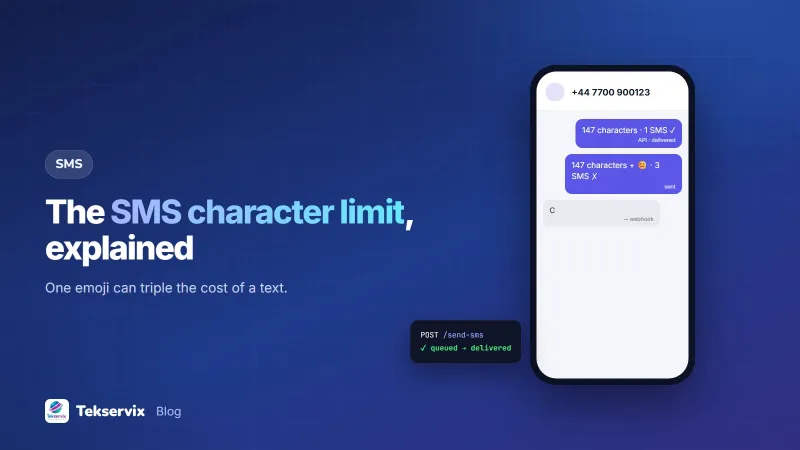
So a 161-character standard message is two parts, and 307 characters is three. With one emoji, a 150-character message needs three parts (67 + 67 + 16). Operators usually bill each part as a separate SMS.
Characters that count double#
A few characters are in the GSM alphabet's extension table and take two character spaces each, even in a standard message:
€ [ ] { } ^ ~ \ |
The euro sign is the one that catches businesses. A price list with several € signs can push a message just over 160.
Hidden culprits#
The characters that switch messages to Unicode are often invisible when you write:
- Curly quotes and apostrophes (’ “ ”) from word processors and phone keyboards, instead of straight ones (' ").
- Long dashes that word processors insert automatically, instead of a plain hyphen (-).
- The ellipsis character (…) instead of three dots.
- Non-breaking spaces copied from websites.
- Emoji, even one.
Paste templates into a plain text editor, or a character counter that shows the encoding, before using them in a campaign.
Languages#
- English, Spanish (without ñ or accents) and Swahili use standard Latin letters and normally fit the 160-character alphabet.
- French mostly fits, but letters such as ê, â, î, ô and û push the message to Unicode, while é, è and à don't.
- Arabic, Amharic, Chinese and other non-Latin scripts always use Unicode, so plan for 70 characters per SMS.
Our guide to bulk SMS costs and rules has example messages and multilingual tips.
How to keep messages to one SMS#
- Write the essentials only: who you are, the fact, the action.
- Use straight quotes and a plain hyphen.
- Drop the emoji in bulk messages where cost matters.
- Shorten dates and times: "Fri 14 Nov, 10:00" rather than "Friday the fourteenth of November at 10 in the morning".
- Use numbers, not words, for amounts.
- Put links at the end, and use your own short domain if you need one.
- Count before sending, with personalisation included. "Hi {{name}}" can add ten characters for a long name.
Personalised fields are the tricky part: test with the longest name and amount in your list, not the shortest.
When a longer message is fine#
Sometimes two parts are worth it: an appointment reminder with directions, or a detailed delivery instruction. That's a fair choice when you make it deliberately. SMS Gora accepts messages up to 1,600 characters and sends longer texts as multi-part SMS automatically; see the SMS Gora API documentation. With a phone-based gateway, each part is billed by your operator like any SMS you send by hand, so the same arithmetic applies.
Counting in code#
If your software sends texts, calculate the part count before sending and log it. Check whether every character is in the GSM alphabet; if so, use 160/153, otherwise 70/67. Our guide to sending SMS with Python includes a small function that does this.
A worked example#
Imagine a clinic sending 3,000 reminders a month. Its template reads: "Hi {{name}}, just a reminder of your appointment at [Clinic name] tomorrow at 10:00 😊 Please arrive 10 minutes early…". The smiley and the ellipsis character make it Unicode, and at 132 characters it's two parts, 6,000 billed messages a month. Replacing the ellipsis with a full stop and dropping the smiley makes it a single standard SMS, and the next month's bill is roughly halved, with patients receiving exactly the same information. For more on writing texts people act on, see our SMS marketing best practices.
Frequently asked questions
What is the character limit for one SMS?
160 characters when the message uses only the standard GSM alphabet, and 70 characters when it includes any character outside it, such as most emoji, curly quotes or letters like ê and ô.
What happens if my SMS is longer than 160 characters?
It's sent as a multi-part message that the phone joins back together. Each part holds 153 standard characters (or 67 with special characters) because some space is used to link the parts, and each part is usually billed as one SMS.
Why does one emoji make my SMS cost more?
An emoji isn't in the standard SMS alphabet, so the whole message switches to Unicode encoding, where each part holds only 70 characters. A 150-character message with one emoji becomes three billed parts instead of one.

Tekservix Team
The team behind Tekservix
The Tekservix Team builds and supports Tekservix: WhatsApp and SMS APIs, AI tools, invoicing, PDF and SEO tools for growing businesses. We write practical, tested guides based on what we see our customers do every day.
More articles from the Tekservix Team