WAservix vs Twilio: Twilio WhatsApp Pricing and a Flat-Fee Alternative
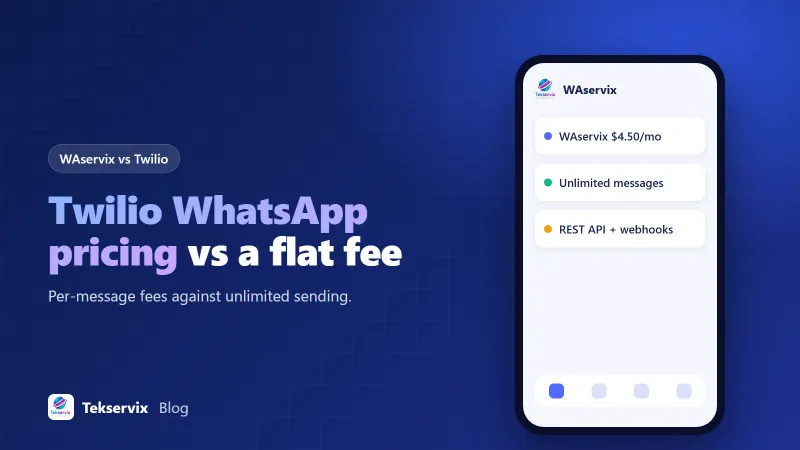
Twilio charges a small fee on every WhatsApp message on top of what Meta charges. WAservix charges a flat monthly fee and nothing per message. We work through what that means at different volumes.
On this page
Developers usually meet Twilio WhatsApp pricing as a tidy little line: $0.005 per message. The surprise comes when Meta's own fees land on top of it, and when October 2026's rule changes start charging for messages that used to be free. WAservix, the WhatsApp API we run at Tekservix, takes a blunter approach: a flat $4.50 a month for a number and no per-message fee from anybody.
So is that a straight win? No. You're comparing an official, globally compliant platform with a linked-device gateway. What you can do is work out what each one costs you, and what each one risks. Let's do that with real figures.
Twilio WhatsApp pricing: what you actually pay#
A Twilio WhatsApp message has two prices stacked together. Twilio's $0.005 applies to messages on its platform. Then Meta's fee applies based on category (marketing, utility, authentication, service) and the recipient's country code. Meta moved to per-message billing in July 2025.
The rule change that matters most came on 1 October 2026. Service messages now cost money past the free 1,000 a month per number, and utility messages sent inside an open 24-hour window are no longer free. If you built a Twilio integration a year ago on the assumption that customer service replies cost nothing except Twilio's fee, your margin has just changed. Twilio posted notices about this, and it's worth reading them if you're on that platform.
Side by side#
| WAservix | Twilio WhatsApp | |
|---|---|---|
| Platform fee | $4.50 to $79/mo flat | $0.005 per message |
| Meta's fees | None | Yes, by category and country |
| Number | Your own, via QR code | Registered sender through Meta |
| Time to first message | Minutes | Business verification, sender registration, templates |
| Message types | Text, media, documents, stickers, locations, contact cards | Text, media, templates, interactive messages |
| Marketing templates | Not needed | Required outside the service window |
| Ban or suspension risk | Higher if misused | Lower, policy managed |
| Global compliance support | You handle it | Enterprise-grade |
What 10,000 messages a month costs#
Say a Lagos retailer sends 10,000 messages a month: 7,000 order updates and 3,000 promotions, to customers who opted in.
On Twilio, the platform fee alone is $50. Meta's fees vary by market, so check the current rate card for your recipients and add it on. One published example puts a US utility message at $0.0034, which would mean about $24 for those 7,000 if they were American. Marketing messages cost a good deal more than utility ones in most markets.
On WAservix Starter, the bill is $4.50. At a million messages a month, Twilio's platform line is $5,000 and WAservix's is still $4.50, although nobody sensible would push a million messages through one linked number. That's where the comparison stops being fair, and we'll come back to it.
Why developers choose WAservix#
Speed is a big part of it. Sign up, scan a QR code and make your first API call before your coffee cools. There's no waiting on display name approval, no template review, no business verification. For a prototype, an internal tool or a client demo, the official process is a real drag.
The API is straightforward too: REST endpoints, webhooks for inbound messages, and support for media types without template rules. Webhooks come with an X-Webhook-Signature header carrying your device secret, so you can check where a call came from. The API docs are open to read.
It also fits uses Twilio was never priced for. Alerts to your own staff. Delivery updates to a small fleet of drivers. A monitoring bot that messages your on-call engineer. Paying per message for those feels wrong, and on WAservix you don't.
You'll also get more than a raw API. Bulk campaigns and auto-replies are in every plan, and if you want an AI answering your customers, our AI Sales Agent plugs into the same number.
Why Twilio is still the right answer sometimes#
WAservix sits on a linked-device connection that Meta doesn't sanction. Most responsible senders run for a long time without trouble, but the risk isn't zero, and Twilio's route doesn't have that risk.
So choose Twilio when your product's core promise depends on WhatsApp staying up. A SaaS that sells WhatsApp notifications to enterprise customers can't explain away a banned number. Choose it if you need audited compliance or a data processing agreement that your legal team recognises. And choose it if you're sending at volume across many countries: Twilio has tooling for that, and a single linked number never will.
Twilio also gives you one vendor for SMS, voice and email. If those are already there, adding WhatsApp barely costs you any engineering time. The Twilio WhatsApp alternatives article we published earlier looks at some other official options too.
Migrating a small project from Twilio#
If you've decided your use case doesn't need Twilio, moving is mostly a small code change. In a typical integration you'd swap the HTTP call, map statuses, and point an inbound webhook to your handler. Here's roughly what to plan for:
- Link a number that can stay online, preferably not your personal one.
- Replace template sends with plain messages, keeping the same wording.
- Add your own opt-out handling, since nobody enforces it for you.
- Slow sending down. Add a delay between messages so the pattern looks human.
- Test webhooks against the signature header.
Then keep Twilio live for a week and run both in parallel on a small slice of traffic. Compare delivery and replies.
Reliability, honestly compared#
Twilio's WhatsApp traffic runs on Meta's servers, with no phone in the chain. Your side stays up as long as your code does. That's a strong position, and you'd struggle to beat it.
WAservix depends on a linked session, so there are more moving parts. If the phone stays off for long enough, the session can end and you'll need to scan again. We keep the gateway running and it holds up well, but a business should plan for the odd reconnect. Keep the phone charged, keep it on a stable connection, and have someone get an alert when a device drops. That's a few minutes of care a month, in exchange for a flat bill.
Think about failure in terms of what it costs you. If a reminder goes out an hour late, nobody's harmed. If a two-factor code doesn't arrive, somebody's locked out. So route the first kind through the cheap channel and keep the second on a route with stronger guarantees, even if that means SMS or Twilio for those few messages.
Common questions from teams leaving Twilio#
Can we keep the same number? If your number's currently registered on the official platform, you'd need to remove it first, and that can take some planning. Many teams simply use a different number for the flat-fee traffic. Will customers notice? They'll see a normal WhatsApp chat, without any verified business label. Can we still send to groups? Linked-device tools handle things official APIs often don't, but check the docs for your exact need before you commit.
Our recommendation#
If you're a startup, an agency or an internal team and your recipients expect to hear from you, start on WAservix. The $1 trial and $4.50 plan make it close to free to find out whether it does the job. If you're selling reliability to enterprises, stay on Twilio, and treat the fees as the cost of that promise. For many companies, the honest answer is one of each: official for customer-facing commitments, and flat-fee for everything else.
Frequently asked questions
How much does Twilio charge for WhatsApp messages?
Twilio adds a $0.005 per-message fee, on top of whatever Meta charges for that message's category and destination. Twilio's support notices from October 2026 confirm its own fee hasn't changed, while Meta's rules on service and utility messages have.
Why is WAservix so much cheaper than Twilio?
It works differently. WAservix links your existing number as a device and passes no message through Meta's paid platform, so nobody charges per message. You give up official status, templates and the guarantees that come with them.
Should developers use Twilio or WAservix for WhatsApp?
Use Twilio if you need an official sender, global compliance or integration with existing Twilio Studio flows. Use WAservix for internal alerts, opted-in notifications, prototypes and products where a flat cost matters more than official status.

Tekservix Team
The team behind Tekservix
The Tekservix Team builds and supports Tekservix: WhatsApp and SMS APIs, AI tools, invoicing, PDF and SEO tools for growing businesses. We write practical, tested guides based on what we see our customers do every day.
More articles from the Tekservix Team