WAservix vs Meta's Official API: WhatsApp Cloud API Pricing and the Real Work Involved
Meta's Cloud API has no platform fee, so it looks free. But message fees, templates and development time all count. Here's an honest look at it next to WAservix's flat monthly price.
On this page
- How WhatsApp Cloud API pricing works in late 2026
- WAservix and the Cloud API compared
- The cost nobody puts in the spreadsheet
- Where a flat fee beats per-message billing
- When the Cloud API is the smarter choice
- Templates: the hidden tax on your time
- What happens if you start on one and move to the other
- A simple way to choose
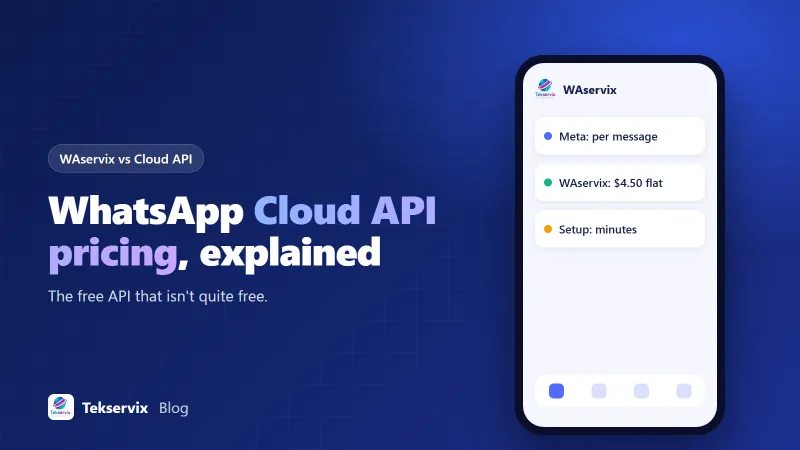
WhatsApp Cloud API pricing has one attractive line: Meta charges no platform fee. You sign up, get hosted access and pay only for the messages you send. Compare that with WAservix, our flat-fee WhatsApp API at $4.50 a month, and Meta seems to win automatically. Often it doesn't, and the reason is everything you have to build and manage around that free API.
We sell one of these two, so you'd expect us to favour it, and we'll try to make the case with facts you can check. There are plenty of companies for whom Meta's API is exactly right, and we'll list them too.
How WhatsApp Cloud API pricing works in late 2026#
Everything here comes from Meta's own pricing documentation. A short version:
- Meta charges per delivered message from business to user. Messages from users are free.
- The rate depends on category and the recipient's country code.
- Marketing, utility and authentication messages are templates, which Meta must approve.
- Service messages are free-form replies inside the 24-hour window.
- Each number gets 1,000 free service messages a month, and they don't roll over.
- Since 1 October 2026, service messages beyond that are charged, and utility messages inside an open window are too.
- Replies within the free entry window after a Click to WhatsApp ad, which can run up to seven days, are free for those categories.
- Volume tiers lower utility and authentication rates as you grow.
Rates change on a fixed quarterly cycle, so your costs can move four times a year. Businesses without a payment method on file by 30 September 2026 risked having service messages stop being delivered, which shows how seriously Meta took the shift.
WAservix and the Cloud API compared#
| WAservix | Meta Cloud API | |
|---|---|---|
| Platform cost | $4.50 to $79/mo | $0 |
| Per-message cost | $0 | Meta's rate card |
| Setup | Scan a QR code | Meta business portfolio, app, phone number, display name |
| Message rules | Send normal messages | Templates outside the service window |
| Bulk campaign tool | Included | Build it yourself |
| Auto-replies | Included | Build it yourself |
| Inbox | Dashboard | Build it yourself |
| Status | Unofficial, linked device | Official |
| Phone needed online | Linked session must stay healthy | No |
The cost nobody puts in the spreadsheet#
A Cloud API number is an endpoint, nothing more. There's no screen where a member of staff can read a customer's message. Nothing runs a campaign, handles opt-outs or keeps conversation history. All that is either code you write or software you buy, and buying it brings you to WATI or respond.io territory, with a monthly fee on top of Meta's rates.
Suppose a developer at a Toronto property manager spends three weeks building a basic inbox, template manager and webhook handler. Even at a modest day rate that's more than a decade of a WAservix Starter plan. Then someone has to maintain it, and Meta's API version changes need attention too. If you were always going to build a custom product, that's fine. If you only wanted to send reminders, it's a lot of work for a text-shaped problem.
Where a flat fee beats per-message billing#
WAservix's model suits anyone whose traffic is high or uneven. Some examples:
A Jakarta school sends each parent a daily attendance notice. That's a utility message every school day, and across 2,000 families the Meta bill grows quickly. The flat fee doesn't move.
A Dubai hotel sends a welcome message, Wi-Fi details and checkout reminders. Templates need approval, and wording changes need new approval. On WAservix the front desk can update the text in a minute.
A logistics firm sends status updates to its own drivers. They're staff, and nobody's going to report those messages as spam. Paying per message for internal chatter makes no sense.
And there's a benefit that's easy to miss: your number stays yours, on your phone. Your staff can keep using it in the normal app alongside the API, since it's linked the same way as WhatsApp Web.
When the Cloud API is the smarter choice#
Meta's route wins clearly if your business falls into any of these groups:
- Regulated industries. Banks, insurers and health providers need approved channels. Don't use a linked-device tool here.
- Low outbound, high inbound. If customers message you and you answer fewer than 1,000 times a month per number, you might pay close to nothing.
- Ad-driven businesses. Click to WhatsApp ads earn you the free entry window, which is a real advantage for lead generation.
- Software companies. If WhatsApp is a feature of your product, build on the official platform so you can make promises to your own customers.
- Large teams wanting a green badge path. Meta's verification sits on this route.
There's also the plain matter of risk. Meta doesn't sanction linked-device automation. If you misuse WAservix your number can be restricted, and no support ticket from us can overturn WhatsApp's decision. Our API versus Business app guide is a good primer if these routes are new to you, and the gateway comparison looks at the architecture.
Templates: the hidden tax on your time#
Anyone who's run the official API for a while has a template story. You write a friendly reminder, submit it, and it comes back recategorised as marketing because of one promotional phrase. Now it costs more. Or it's rejected, and your campaign waits while you reword it. Templates also carry a fixed structure, so personalising beyond the placeholders takes planning.
There are good reasons for all this. Templates stop businesses from flooding people with junk, and they've helped keep WhatsApp a pleasant place to read messages. But they do add a step between having something to say and saying it. With WAservix, a staff member types the message and it goes. That's great for a business that changes offers weekly. It also means nobody is checking your judgement, so do that yourself.
What happens if you start on one and move to the other#
Start on a flat fee and grow into the official platform, and you've lost little. Your code needs a new sending function and your messages need turning into templates. Plenty of companies test demand this way, then move customer-facing traffic to Meta's route once the numbers justify it.
Going the other way is less common. The usual reason is a cost shock, like the October 2026 change, on traffic that was never high value. If that's you, move only those low-value messages, and keep anything customers rely on where it is. Use a separate number to keep the two clean, so a problem on one line never reaches the other, and so your monthly reports stay easy to read.
A simple way to choose#
Write down three numbers: messages you send per month by category, the rate for your main country, and what you'd pay a developer to build the missing parts. Multiply and add. Then set that beside $4.50, or $12 for three numbers.
If the Cloud API total is close to the flat fee, go official and enjoy the peace of mind. If it's ten times higher, you have a real choice to make, and the deciding factor is how badly a restricted number would hurt you. For a business messaging customers who've asked to hear from it, we think that risk is manageable, and a $1 trial is a cheap way to find out.
Frequently asked questions
Is the WhatsApp Cloud API free?
The API itself has no platform fee, but Meta charges per delivered message depending on category and country. Each business number gets 1,000 free service messages a month. Marketing, utility and authentication templates are charged, with some exceptions such as the free entry point window after Click to WhatsApp ads.
Do service messages cost money on WhatsApp now?
Yes. Since 1 October 2026 Meta charges for service messages beyond the 1,000 free per number each month. Eligible government and non-profit bodies keep free service messages beyond that tier through 31 December 2027.
What's the difference between WAservix and the Cloud API?
The Cloud API is Meta's official service: you verify your business, use approved templates and pay per message. WAservix links your existing number by QR code and charges a flat monthly fee, but it's not an approved Meta route, so it carries some risk of restriction if misused.

Tekservix Team
The team behind Tekservix
The Tekservix Team builds and supports Tekservix: WhatsApp and SMS APIs, AI tools, invoicing, PDF and SEO tools for growing businesses. We write practical, tested guides based on what we see our customers do every day.
More articles from the Tekservix Team