WAservix vs Zoko: A Zoko Alternative for Stores That Don't Use Shopify
Zoko is a strong WhatsApp tool for Shopify brands, with add-ons for AI and sales. WAservix is a flat-fee API for any kind of business. Here's how to tell which suits your store.
On this page
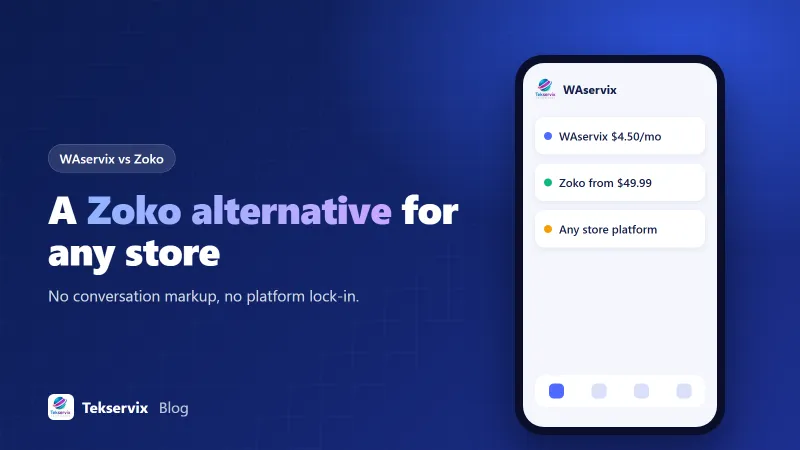
Zoko has built a good reputation among Shopify brands, and if that's you, it may be exactly what you need. But if you're looking for a Zoko alternative, there's probably a reason: you're not on Shopify, the add-ons have started to stack up, or you simply want WhatsApp without the commerce layer. WAservix, the flat-fee WhatsApp API we build at Tekservix, works with any store or none at all, starting at $4.50 a month with no conversation markup.
Let's break down what a Zoko bill looks like, and then look at what you'd swap by moving.
What goes into a Zoko bill#
| Item | Zoko | WAservix |
|---|---|---|
| Base plan | $49.99, $79.99 or $139.99/mo | $4.50 to $79/mo |
| Conversation markup | $0.015 on Starter, included up to a limit on higher plans | None |
| Meta's message fees | Paid to Meta | None |
| Agents | Unlimited on Starter, 5 free on Plus, 10 free on Elite | Account based |
| $9.99/mo | Not included | |
| Premium flows | $5.99/mo each | Use auto-replies or your own code |
| AI add-ons | $24.99/mo plus $0.09 per resolution | AI Sales Agent, from $29/mo |
| Sales add-on | $24.99/mo plus 3% of order value | Not included |
Zoko's details come from its pricing page, checked on 30 October 2026. Those add-ons are optional, but they're what many shops end up wanting, so include them when you do your sums.
Why shops look for a Zoko alternative#
The first reason is platform fit. Zoko's reputation comes from Shopify. If you're on WooCommerce, a marketplace or a custom site, you're not getting the best of it. WAservix doesn't care what you sell on. It offers a REST API and webhooks, so anything that can make a web request can send an order update.
The second reason is that the costs add up in layers. A shop on Plus with Instagram, one premium flow and an AI add-on is already above $120 a month before Meta's fees, resolutions or order percentages. Every piece is reasonable alone. Together, they're a real line on a small store's profit and loss.
The third is growth by message. Meta's fees rise with your sends, and that's before the October 2026 change, which added charges for service messages past 1,000 a month and for utility messages inside an open window. See Meta's pricing docs for details. For stores sending lots of order updates, that's a meaningful shift.
What running a store on WAservix looks like#
Take a Nairobi coffee roaster selling through its own site, with 3,000 customers. Here's a realistic setup.
Order confirmations come from a webhook. When the shop records a sale, a small script calls the WAservix API with the customer's name and order number.
Dispatch updates work the same way, with the tracking link.
A weekly new-roast announcement goes out as a campaign from the dashboard, to people who ticked the box at checkout.
Auto-replies cover shipping times and opening hours.
The bill is $4.50 a month. It takes a few hours to set up, and somebody needs to look after the script. For a shop with any technical help, that's a good deal. For a shop with none, it's a reason to think twice, because Zoko's one-click approach exists to remove that work.
What Zoko does better#
If you're on Shopify, its integration is the big one. Cart recovery, order notifications and catalogue sharing work with little setup, and they're designed around how Shopify brands operate.
Team inbox features are strong as well. Support and sales staff can share conversations on one number. Starter even includes unlimited agents, which is unusual.
It's also an official platform. Your number sits on Meta's approved API, with templates and a path to verification. WAservix doesn't offer those. It links your number as a device, an approach Meta hasn't approved, and a number that gets reported often can be restricted. We don't hide that, and neither should you when you plan your business around it.
Zoko also supports WhatsApp calling at Meta's rates, which may suit some shops.
Comparing AI add-ons#
Zoko's Guru and Wismo cost $24.99 a month plus $0.09 per resolution, with the first 100 free. So 2,000 resolutions a month would run about $196 once you've taken off the free ones.
Our AI Sales Agent takes a flat approach: Starter is $29 a month for 1,000 AI replies, Growth is $79 for 5,000 and Business is $199 for 20,000. Each includes WhatsApp and SMS. A reply and a resolution aren't the same thing, since one conversation can take several replies, so they don't compare one to one. But a flat cap is easy to budget for, and it learns from your website without any flow building. There's a $3 seven-day trial.
Handling opt-ins at checkout#
However you send, get permission properly. Add a clear tick box at checkout: "Send me order updates and offers on WhatsApp." Don't pre-tick it. Store the date and what they agreed to. Separate transactional updates from marketing, since a customer may want one and not the other.
That simple step protects your number, keeps you within the law in most countries and improves your results, since people who chose to hear from you are more likely to read what you send. Our opt-in guide has sample wording.
Cost comparison for a growing store#
| Monthly activity | WAservix | Zoko Plus |
|---|---|---|
| Base plan | $4.50 | $79.99 |
| Conversations within plan | $0 | Included up to 5,000 at $0 markup |
| Meta fees on 10,000 messages | $0 | Depends on country and category |
| Not available | $9.99 | |
| Total before Meta | $4.50 | $89.98 |
What about WooCommerce and custom stores?#
WooCommerce store owners ask us this often. WordPress can fire a webhook when an order changes status, and a few lines of code, or an automation tool, can turn that into a WAservix API call. You can pass the customer's name, order number and tracking link, and word the message any way you like.
Custom stores have it easier still, as your developer can call the API straight from your order code. Marketplace sellers without access to order events can export a list each day and run a campaign, which isn't elegant but does the job. The WAservix docs show the calls you'd need. Keep the phone number in full international format and check it before sending, because a badly formatted number is an easy way to lose an order update, and nobody notices until the customer calls to ask where their parcel is.
Who should stay, who should go#
- Stay on Zoko if you're a Shopify brand with a support team, use its automations and want an official number.
- Stay if a one-click setup is worth more to you than the monthly saving.
- Go if you're not on Shopify, or you send far more than you receive.
- Go if you have a developer, or even a technical friend, who can connect a webhook.
- Go if you're paying for add-ons you barely use.
Our recommendation#
List what you use on Zoko today, line by line, with what each piece cost you last month. Then ask which items bring in sales. If it's mainly order updates and broadcasts, try moving those to a $1 WAservix trial, using a separate number. You can also see how we compare with Interakt, another commerce-focused platform, and read our full WhatsApp API roundup.
Frequently asked questions
How much does Zoko cost?
Zoko's pricing page lists Starter at $49.99 a month with a $0.015 conversation markup, Plus at $79.99 and Elite at $139.99. WhatsApp messages are paid to Meta at its rate card, and add-ons such as Instagram, Flows, Guru and Sello cost extra.
Do I need Shopify to use WAservix?
No. WAservix isn't tied to any store platform. Anything that can make an HTTP request can send a message, so WooCommerce, a custom shop or a spreadsheet script all work. You can also run campaigns by hand.
Which is better for abandoned cart messages?
Zoko is quicker to set up on Shopify because it's built for that. With WAservix, you'd trigger the message through a webhook or small script, which takes some effort but carries no per-message fee.

Tekservix Team
The team behind Tekservix
The Tekservix Team builds and supports Tekservix: WhatsApp and SMS APIs, AI tools, invoicing, PDF and SEO tools for growing businesses. We write practical, tested guides based on what we see our customers do every day.
More articles from the Tekservix Team