Free SMS API Options: What's Really Free, What Isn't, and the Cheapest Route
Search for a free SMS API and you'll find plenty of promises. In practice, every text costs someone money to deliver. Here's what 'free' really means across trial credits, test modes, email-to-SMS and phone gateways, and how to send cheaply once the free part runs out.
On this page
Every developer building their first OTP screen or reminder system types the same search: free SMS API. And the results look promising. "Free to start." "Free credits." "Send SMS free." Then you read the small print, and somewhere there's a per-message price, an expiry date or a limit of one text a day.
That isn't companies being sneaky. It's how SMS works. Mobile networks charge to carry text messages between networks, and someone has to pay that fee. So the useful question isn't "where is the free one?" It's "which kind of free fits what I'm doing, and what's the cheapest route after that?" Here's an honest map.
Option 1: trial credits#
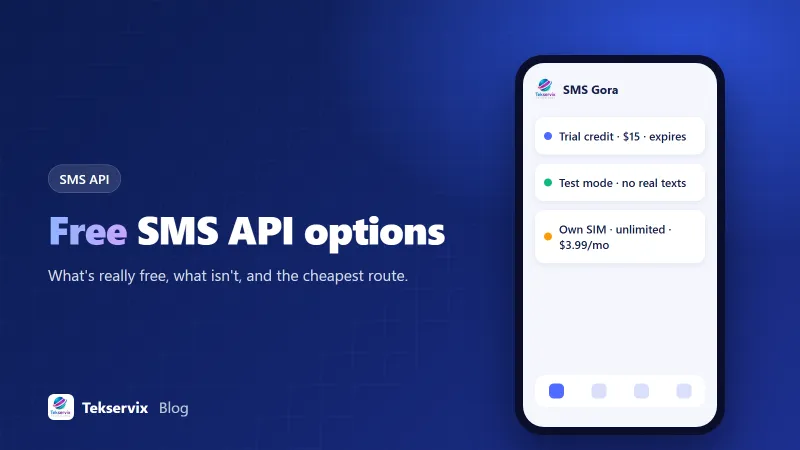
Most large SMS providers give new accounts a small amount of credit, enough for anywhere from a handful to a few hundred messages depending on the country. It's genuinely useful for building and testing an integration.
The catches are predictable:
- Credit expires or runs out quickly.
- Trial accounts often can only send to verified numbers, usually your own.
- Messages may carry a "sent from a trial account" prefix.
- Some countries need sender registration before anything goes through, trial or not.
Good for: proving your code works. Not good for: anything customers will see.
Option 2: test modes and sandboxes#
Some APIs offer test credentials or magic phone numbers that simulate success and failure without sending real messages. They're free because nothing reaches a network.
This is the right tool for automated tests and CI pipelines. You don't want every test run to send real texts and cost money. But it obviously won't deliver an OTP to an actual user.
Option 3: tiny free daily allowances#
A few services let you send one or a few free messages a day, mainly for hobby projects. They're fine for a personal alert from a home server. They're not fine for a business: limits are low, there are usually no delivery guarantees, and the sender details can vary.
Option 4: email-to-SMS gateways#
For years, some carriers let you email an address like number@carrier-domain and delivered it as a text. It looked like free SMS. Today it's an unreliable route: many carriers have restricted or retired these gateways, you need to know each recipient's carrier, messages can be delayed or dropped, and they're often filtered as spam. Don't build anything important on it.
Option 5: your own phone as a gateway#
This is the closest thing to free that actually works at business scale. An app on an Android phone connects to a cloud API; your code calls the API; the phone sends the text from its own SIM. The cost per message is whatever your mobile plan charges, and in many countries plans with large or unlimited text bundles are cheap.
What you pay for is the software that turns the phone into a reliable, API-controlled gateway: queueing, delivery reports, incoming message webhooks, multi-phone support. Some open-source gateway apps are free if you run and maintain the server side yourself. Hosted services charge a monthly fee instead of per-message prices.
Limits to know about:
- Each phone can only send so fast. Our guide to the Android SMS sending limit explains why, and how to scale with more phones.
- Your carrier's fair-use terms apply. Check that business messaging is allowed on your plan.
- Recipients see a normal mobile number, not a brand name.
Comparing the real cost#
Here's a rough way to compare. Say you send 3,000 texts a month to customers in one country.
- Per-message provider: 3,000 times your country's per-message rate. Depending on the country, that ranges from modest to very expensive, and international messages cost more.
- Phone gateway: a monthly software fee plus your SIM plan. If the plan includes unlimited texts, the cost stays the same whether you send 3,000 or 30,000.
Look up the actual rates for your destination countries before deciding. Prices vary enough that the answer can change completely between countries.
What "free" shouldn't cost you#
When an SMS route is cheap, check the things that matter more than price:
- Delivery reports, so you know which messages actually arrived.
- Replies and opt-outs: can customers text STOP and be removed automatically?
- Reliability: what happens to queued messages if something goes offline?
- Security: API keys, HTTPS, and signed webhooks so nobody can fake incoming messages.
- Support: who helps when OTPs suddenly stop arriving at 9pm?
An API that saves a few dollars but loses messages will cost you far more in failed sign-ups and annoyed customers. Our guide to OTP SMS not received shows how much can go wrong in delivery.
OTP codes: a special case#
One-time passcodes are the most common reason people look for a free SMS API, and they're also the messages you can least afford to lose. A sign-up that never receives its code is a lost customer. A few things help keep OTP costs down without hurting delivery:
- Rate-limit code requests per number and per IP address, so bots can't burn through your budget by requesting thousands of codes. This kind of abuse, sometimes called SMS pumping, targets per-message routes in particular.
- Offer alternatives where they suit your users, like email codes or an authenticator app, and keep SMS as the fallback.
- Don't resend automatically. Let the user tap "Resend code" after 30 to 60 seconds.
Our guide to SMS OTP verification covers the full flow.
Where SMS Gora fits#
SMS Gora takes the phone-gateway route and handles the hard parts. Connect an Android phone, then send through a REST API with an API key, from the dashboard, or from a spreadsheet. You get delivery reports, incoming messages by signed webhook, keyword auto-replies, automatic STOP handling and support for dual-SIM phones. Plans start at $3.99 a month with unlimited SMS, and you add phones as volume grows. If you're already using a TextBee-style integration, SMS Gora accepts the same request format, so switching is mostly a matter of changing the base URL and key.
A practical plan#
- Build and test with a sandbox or trial credits so your tests don't send real messages.
- Before launch, estimate monthly volume and destination countries.
- Price the per-message route and the phone-gateway route with real numbers.
- Pick the cheaper option that still gives you delivery reports, opt-outs and support.
Free SMS doesn't really exist past the testing stage. Cheap, reliable SMS does, and for most small and medium senders it's closer to free than you might expect.
Frequently asked questions
Is there a completely free SMS API?
Not for real, ongoing use. Mobile networks charge to deliver texts, so someone always pays. Free options are trial credits, test modes that don't send real messages, or very small daily allowances meant for testing.
What is the cheapest way to send SMS from code?
For local messages at moderate volumes, a phone-based SMS gateway on a SIM plan with a large or unlimited text bundle is usually cheapest. For international or very high volume sending, compare per-message prices from carrier-connected providers.
Can I send SMS through email for free?
Some carriers used to accept emails to addresses like number@carrier-domain and deliver them as texts. Many have restricted or shut these gateways down, and delivery was never guaranteed, so it isn't a dependable option for business messages.

Tekservix Team
The team behind Tekservix
The Tekservix Team builds and supports Tekservix: WhatsApp and SMS APIs, AI tools, invoicing, PDF and SEO tools for growing businesses. We write practical, tested guides based on what we see our customers do every day.
More articles from the Tekservix Team