SMS Gateway vs SMS API: What's the Difference and Which Do You Need?
People use 'SMS gateway' and 'SMS API' as if they mean the same thing. They overlap, but the route your messages take makes a real difference to cost, sender ID and volume. Here's how to tell them apart and choose.
On this page
- Two words for two layers
- Route one: carrier-connected providers
- Route two: phone-based gateways
- Comparing them on what you actually care about
- Cost
- Who the message appears to come from
- Speed and volume
- Replies
- Paperwork
- What a good SMS API looks like, whatever the route
- A quick way to decide
- Where SMS Gora fits
Search for a way to send texts from your software and you'll meet both phrases within minutes. One site sells an "SMS gateway". Another sells an "SMS API". A third says it's both. It's confusing, and it matters, because the choice affects what you pay per message, what name appears on the recipient's phone and how many texts you can send in an hour.
So here's the sms gateway vs sms api question explained without the jargon, with a simple way to decide which setup suits you.
Two words for two layers#
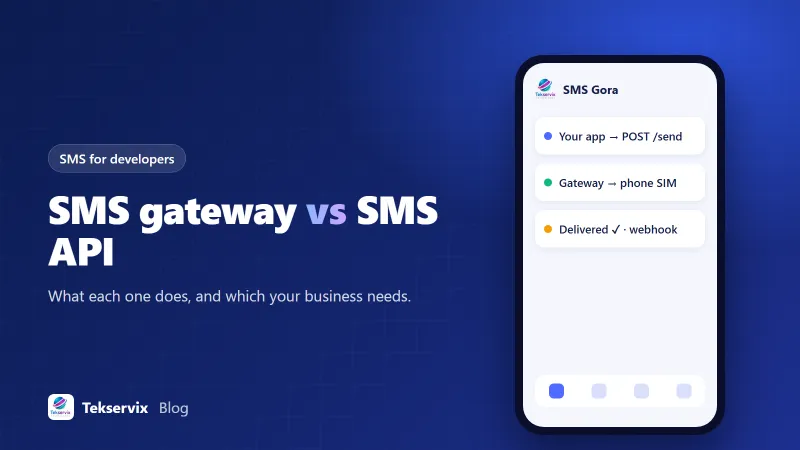
An SMS API is the doorway your software uses. Your app sends a request, usually over HTTPS, saying "send this text to this number". The API accepts it, gives you an ID and later tells you whether it was delivered.
An SMS gateway is the machinery behind the doorway. It takes the message and hands it to a mobile network so it can reach a phone. That might be a direct connection to carriers, a chain of wholesale providers, or an ordinary Android phone with a SIM card.
Put simply, nearly every service you'll consider has an API in front of a gateway. The real question isn't "gateway or API?" It's "what kind of gateway sits behind the API I'm using?"
Route one: carrier-connected providers#
The big SMS platforms connect to mobile networks through aggregators and direct carrier links. You buy credit or pay per message, and the provider routes each text across whichever connection reaches that country.
Strengths:
- Very high throughput, often hundreds of messages a second.
- Alphanumeric sender IDs (your brand name instead of a number) in countries that allow them.
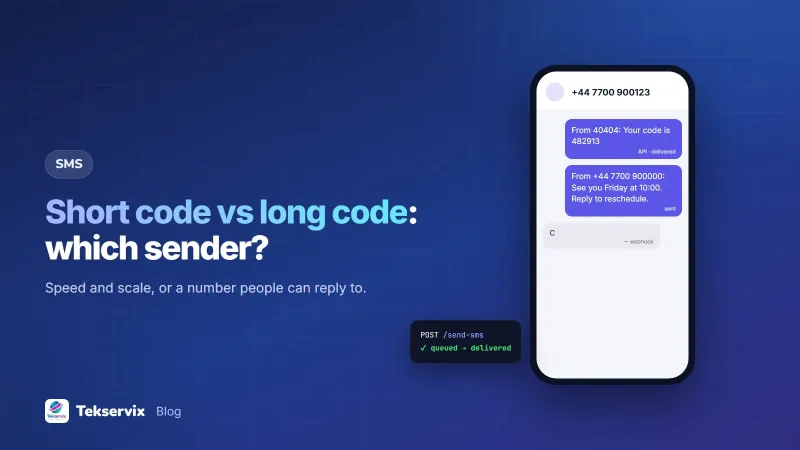
- Short codes and registered long codes for markets like the US, where carriers expect business texting to be registered.
- Coverage of many countries from one account.
Trade-offs:
- You pay for every message, and prices vary widely by country. International rates can add up fast.
- Registration and paperwork, such as 10DLC in the US or sender ID approval in some countries, can take days or weeks.
- Replies may cost extra or need a dedicated virtual number.
Our explainer on 10DLC registration covers the US side of this in detail.
Route two: phone-based gateways#
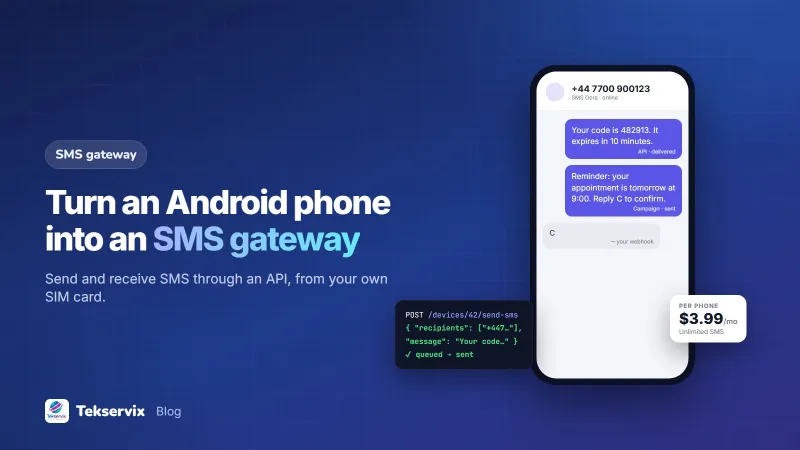
A phone-based gateway uses a real Android phone and SIM to send messages. An app on the phone connects to a cloud service; your software calls that service's API; the phone sends the text as if someone typed it.
Strengths:
- Messages go out on your own SIM plan, so with a generous local bundle the cost per text can be close to nothing.
- Recipients see a normal local mobile number they can reply to, call or save as a contact.
- Replies come back to the same number for free, which suits two-way conversations.
- No sender registration in many countries, because you're using an ordinary subscriber number.
Trade-offs:
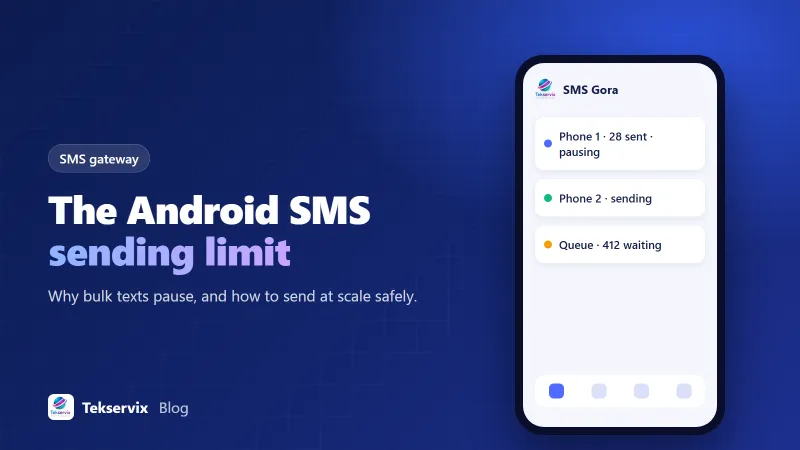
- Lower throughput per phone. Android and carriers both limit how fast one SIM can send, which is why you add phones for volume.
- No alphanumeric sender ID.
- Depends on the phone staying powered, online and allowed to run in the background.
- Carrier fair-use terms apply. Check that your plan permits business messaging.
We wrote a full guide to the Android SMS sending limit if you want the detail on throughput.
Comparing them on what you actually care about#
Cost#
For a business sending a few thousand texts a month within one country, a phone gateway on a bundle plan is usually far cheaper. Per-message pricing wins when volumes are huge, when you send to many countries, or when your local SIM plans are expensive.
Who the message appears to come from#
If you need "ACMEBANK" as the sender, you need a carrier route that supports sender IDs in that country. If a local number is fine, or even better because customers can reply, a phone gateway works.
Speed and volume#
An OTP code to one person? Both routes deliver in seconds. Ten thousand marketing messages in five minutes? That's carrier-route territory. Two thousand reminders spread over an evening? A few phones handle it comfortably.
Replies#
Phone gateways shine here. Customers text back the same number, and replies arrive in your inbox or as webhooks without extra setup. Some carrier routes are one-way unless you rent a number.
Paperwork#
Phone gateways can be running in an afternoon. Carrier routes may require brand and campaign registration depending on the country.
What a good SMS API looks like, whatever the route#
Whichever gateway sits behind it, judge the API by the same things:
- A clear send endpoint with simple authentication, ideally an API key in a header.
- Delivery status you can query or receive by webhook.
- Webhooks for incoming messages, so replies reach your software instantly.
- Good error messages when a number is invalid or a send fails.
- Code examples in the languages you use. See our guides to sending SMS from Python and from PHP for the typical shape.
- A dashboard for the non-developers on your team.
A quick way to decide#
- Mostly local customers, moderate volume, replies matter: a phone-based gateway with an API.
- Branded sender name required, or very high volume: a carrier-connected provider.
- US business texting at scale: a provider that handles 10DLC or toll-free verification.
- A mix: plenty of businesses use a provider for big bulk campaigns and a phone gateway for day-to-day conversations and reminders.
Where SMS Gora fits#
SMS Gora is a phone-based gateway with a full REST API in front of it. You install the app on an Android phone, connect it to your account, and send from the dashboard, from a spreadsheet import, or from your own code. Incoming texts and delivery reports arrive by webhook, keyword auto-replies and STOP opt-outs are built in, and dual-SIM phones let you choose which SIM sends. Plans start at $3.99 a month with unlimited SMS, scaling by the number of connected phones.
If you're not sure which route suits you, try the cheap one first. Connect a spare Android phone, send your real traffic for a week and look at the delivery reports. You'll know quickly whether it covers your needs or whether you've outgrown it.
Frequently asked questions
Is an SMS gateway the same as an SMS API?
Not quite. The gateway is the system that actually hands messages to the mobile network. The API is the interface your software uses to ask for a message to be sent. Most SMS services give you both: an API in front of a gateway.
Which is cheaper, a phone gateway or an SMS provider?
For moderate volumes, a phone-based gateway is usually cheaper because messages go out on your SIM plan rather than being billed per message. At very high volumes, or where you need a registered brand sender ID, a carrier-connected provider often makes more sense.
Can I use an SMS API without writing code?
Often, yes. Many services, including SMS Gora, have a dashboard for sending campaigns and importing contacts, and connect to tools like Zapier or Google Sheets. The API is there when you want to automate sending from your own software.

Tekservix Team
The team behind Tekservix
The Tekservix Team builds and supports Tekservix: WhatsApp and SMS APIs, AI tools, invoicing, PDF and SEO tools for growing businesses. We write practical, tested guides based on what we see our customers do every day.
More articles from the Tekservix Team