Paraphrasing Tool Guide: Rewrite Text Well (and Honestly)
How to use a paraphrasing tool well: good reasons to rewrite, choosing tone and rewrite strength, checking meaning, avoiding plagiarism, academic rules, SEO and duplicate content, and when to rewrite by hand.
On this page
A paraphrasing tool rewrites text in different words while keeping the meaning. Used well, it turns a stiff paragraph into something people want to read, adapts a formal document for a WhatsApp message, or freshens product copy you've been reusing for years. Used badly, it produces awkward synonyms, changes facts without telling you, or dresses up someone else's work as your own. This guide covers the good uses, the settings that matter, and the checks that keep your rewrite accurate and honest.
Good reasons to paraphrase#
- Clarity: rewriting your own draft that's too long, too formal or full of jargon.
- Tone: turning a formal policy into a friendly customer message, or a casual note into something fit for a client.
- Audience: explaining a technical point for non-specialists.
- Variety: writing several versions of an ad or message to test, or so repeat customers don't see the same text every time.
- Quoting fairly: restating a source's idea in your own words, with credit.
The common thread: you either own the text or you credit it.
Settings that matter#
Most paraphrasing tools offer two main controls. The Tekservix AI Humanizer, which rewrites text so it reads naturally, has both:
- Tone: casual, friendly, professional, formal or academic. Choose for the reader, not for yourself. A delivery update is friendly; a supplier contract summary is professional.
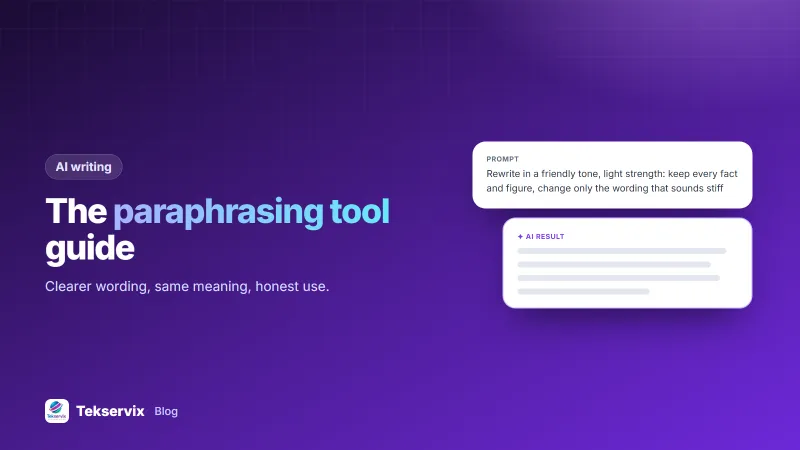
- Rewrite strength: light keeps the text close to the original and changes only what reads badly; balanced reworks sentences; strong restructures paragraphs more freely.
Start light. It's easier to push a rewrite further than to recover meaning a heavy rewrite lost. Longer passages, 150 words or more, give better results than single sentences, because the tool has more context about what you mean.
Check that the meaning survived#
Paraphrasing tools sometimes "improve" text by changing what it says. After every rewrite, compare it with the original and look for:
- Numbers, dates and names: they must be identical.
- Strength of claims: "may help" shouldn't become "will fix".
- Conditions: "only for orders above $50" shouldn't lose its condition.
- Technical terms: a synonym for a precise term is often wrong. "Proforma invoice" is not a "preliminary bill".
- Your voice: read it aloud. If it doesn't sound like your business, edit by hand.
Our tips to make AI writing sound human cover the final edit in more detail.
Plagiarism: rewording isn't the same as writing#
Changing the words of someone else's article doesn't make it yours. The ideas, structure and research still belong to the original author. If you paraphrase a source:
- Credit it, with a link where possible.
- Add your own experience, examples or analysis, so your piece offers something the source doesn't.
- Run a plagiarism check if you're unsure how close the result is; the plagiarism checker in Tekservix SEO tools compares text against what's published online.
Students and academic writing#
Universities treat undeclared paraphrasing tool use very differently. Some allow it for language help, many require you to declare it, and some forbid it for assessed work. Check your institution's policy first. Paraphrasing a source still needs a citation in academic writing, and a rewrite produced by a tool may be flagged in plagiarism or AI checks. Our article on how accurate AI detectors are explains why those flags are unreliable, but that won't help in a misconduct hearing if you broke the rules.
SEO: spinning versus improving#
Taking competitors' articles and rewording them, sometimes called "spinning", is an old tactic that doesn't work. Google's spam policies on scaled content abuse cover content produced in bulk mainly to rank, with little value for readers, regardless of how it was made. Rewritten copies also tend to fail on originality, the thing that makes a page worth ranking. Our guide to duplicate content explains how search engines handle near-copies.
Paraphrasing your own content is a different story. Updating an old article to be clearer and more current, adapting product descriptions so they're not identical to the manufacturer's, or rewriting a page for a new audience all make the web better, and can help rankings.
When to rewrite by hand#
- Legal and financial text, where a changed word changes obligations.
- Very short text, such as a headline or slogan, where you'll do better writing three options yourself.
- Personal messages, such as an apology to an upset customer.
- Anything with your brand's signature phrases, which tools tend to flatten.
A simple workflow#
- Decide the reader and the tone before you paste anything.
- Run a light rewrite first.
- Compare with the original: facts, conditions, terms.
- Edit by hand for voice, and cut anything that adds words without meaning.
- If the source wasn't yours, credit it and add something of your own.
A worked example#
Imagine [Company name], a logistics firm whose terms of service run to two formal pages. Customers rarely read them, and complaints about late collection fees are common. The team pastes the fees section into a paraphrasing tool with a friendly tone and light strength, then checks the result line by line. The rewrite turned "within 72 hours of arrival" into "after a few days", so they restore the exact wording. The final version, a short plain-English box of five bullet points, sits at the top of the terms page and goes out on WhatsApp with each shipment notice. The formal text stays below for legal purposes, and complaints about the fees drop because customers finally understand them.
Frequently asked questions
Is using a paraphrasing tool plagiarism?
Rewording someone else's work without credit is still plagiarism, whether you do it by hand or with a tool. Paraphrasing is fine when you credit the original source, or when you're rewriting your own text, such as making a stiff draft clearer or adapting it for a new audience.
Can paraphrased content rank on Google?
Google rewards helpful, original content, however it was produced. Spinning other sites' articles into new wording adds nothing and can fall under Google's scaled content abuse policy. Rewriting your own content to make it clearer, more current or better suited to readers is fine.
What is the difference between paraphrasing and summarizing?
Paraphrasing restates a passage in different words at roughly the same length, keeping all of its meaning. Summarizing shortens it to the main points. Use paraphrasing to change wording or tone, and summarizing to save the reader time.

Tekservix Team
The team behind Tekservix
The Tekservix Team builds and supports Tekservix: WhatsApp and SMS APIs, AI tools, invoicing, PDF and SEO tools for growing businesses. We write practical, tested guides based on what we see our customers do every day.
More articles from the Tekservix Team