Twilio WhatsApp Alternative: When a Flat Monthly Price Makes More Sense
An honest look at a Twilio WhatsApp alternative: how Twilio and Meta charge per message, when a per-number gateway like WAservix costs less, what you give up, and how to decide.
On this page
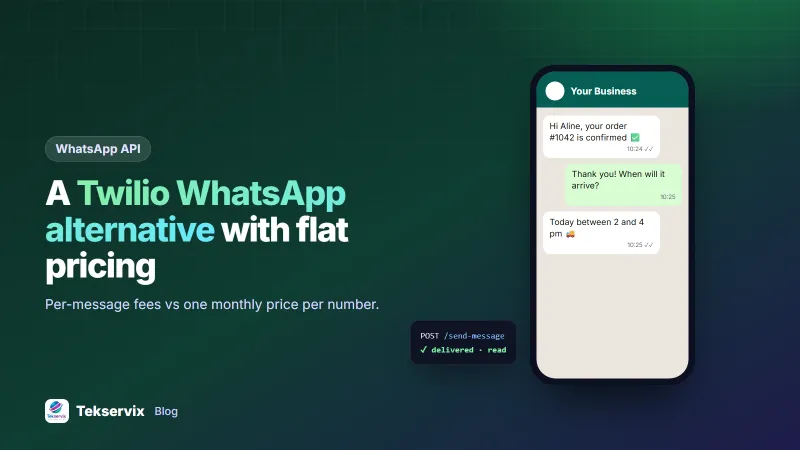
Twilio is a solid way to send WhatsApp messages from software, and plenty of large companies use it. For a business, though, the bill can grow in ways that are hard to predict: a fee on every message in both directions, plus Meta's charges for template messages on top. If you are looking for a Twilio WhatsApp alternative, the real question is whether you need Meta's official API at all, or whether a gateway that links your existing number for a flat monthly price would do the job.
This article compares the two honestly, including the cases where you should stay with Twilio.
How Twilio charges for WhatsApp#
Twilio's WhatsApp pricing page lists a Twilio fee of $0.005 per message, whether the message is sent or received. Meta then charges separately for template messages, which are the pre-approved messages a business sends to start or restart a conversation:
- Marketing templates carry the highest Meta fee, which varies by the customer's country.
- Utility and authentication templates cost less, starting at a fraction of a cent in many countries.
- Free-form replies sent within 24 hours of the customer's last message carry no Meta fee, though Twilio's $0.005 still applies.
Meta explains its side in the WhatsApp Business Platform pricing documentation. On top of the money, you need a verified Meta business, a registered sender and approved templates before you send anything proactive. For a developer at a growing company, that setup is fine. For a ten-person shop that just wants order updates to reach customers, it is a lot of process. Our WhatsApp Business API pricing guide covers Meta's categories in more detail.
The other model: a gateway for your own number#
A WhatsApp gateway links an ordinary WhatsApp or WhatsApp Business number the same way WhatsApp Web does, through the Linked devices screen on your phone. Your software then sends and receives through a REST API. WAservix works this way:
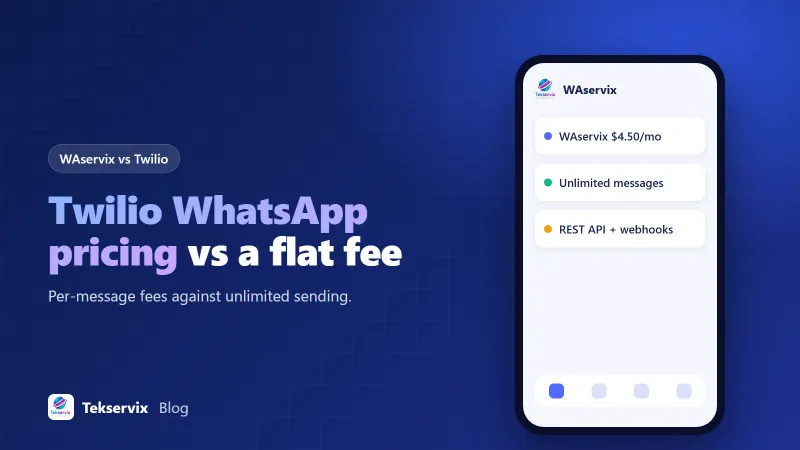
- Price per number, not per message. Plans start at $4.50 a month for one number, $12 for three, $22 for six, $35 for ten and $79 for 25, with unlimited messages. You can try it for three days for $1.
- No template approval. You write whatever message fits the moment, as you would from the phone.
- Webhooks for replies, delivery and read receipts, so your system sees what happens to every message.
- Campaigns and auto-replies from the dashboard, with STOP opt-outs handled automatically.
A cost comparison with real numbers#
Imagine a delivery business sending 10,000 order updates a month and receiving about 10,000 customer replies. Here is the arithmetic:
- Twilio fees: 20,000 messages × $0.005 = $100 a month, before any Meta charges.
- Meta fees: order updates sent outside a 24-hour window must be utility templates, each with its own Meta fee depending on the country.
- WAservix: $4.50 a month for one number, whatever the volume.
At low volumes the gap is small. A business sending 500 messages a month pays Twilio about $2.50 plus template fees, and the official route may be the cleaner choice. The flat model wins clearly once volume reaches the thousands, or when most of your traffic is two-way conversation.
What you give up with a gateway#
A flat price is not free of trade-offs, and anyone selling you one should say so plainly:
- It is not Meta's official API. WhatsApp can restrict or ban numbers that send spam or get reported. Message only people who asked to hear from you, and warm up new numbers slowly. Our guide to warming up a WhatsApp number shows a safe schedule.
- Your phone needs to stay linked. If the phone is logged out of WhatsApp or the number is removed, sending stops until you relink it.
- No verified business badge and no official template tooling.
- Volume limits are behavioural, not contractual. You can't blast 50,000 cold contacts in an hour, and you shouldn't try.
When to stay with Twilio#
- You send high volumes of authentication codes and need guaranteed throughput.
- You work in banking, healthcare or another regulated field where an official, contracted channel is a compliance requirement.
- You already use Twilio for SMS, voice and email and value one bill and one support team.
- Your marketing team needs Meta's official marketing templates and reporting.
When a flat-price gateway fits better#
- You send order confirmations, delivery updates, reminders and follow-ups to existing customers.
- Most of your WhatsApp traffic is conversation, where per-message fees in both directions add up.
- You want to start this week, without business verification and template reviews.
- You run several numbers, such as sales and support, and want a predictable monthly cost.
Switching without rewriting your app#
Moving from Twilio means changing the code that calls the API, since Twilio's endpoints and fields are its own. In most projects the change sits in one function: the one that takes a phone number and a text and sends it. Replace the Twilio call with a POST to the WAservix send-message endpoint, point your incoming webhook at your server, and test with your own number first. If you are coming from WaSender instead, the endpoints already match; see our WaSender API alternative article. Businesses comparing SMS costs too can read our look at a Twilio SMS alternative.
A worked example#
Imagine [Shop name], an online electronics store in Melbourne, sending about 6,000 WhatsApp messages a month through Twilio: order confirmations, shipping updates and replies to customer questions. Their monthly Twilio fee is around $30 for messages alone, plus Meta's utility template charges on shipping updates sent days after the order. They move routine updates and customer replies to one WAservix number at $4.50 a month, opt every customer in at checkout, and keep a Twilio sender for a small volume of login codes where an official channel matters. The monthly WhatsApp bill drops sharply, and nothing customers see changes except that replies arrive a little faster.
Frequently asked questions
How much does Twilio charge for WhatsApp messages?
Twilio charges $0.005 for every WhatsApp message sent or received, and Meta's own fees apply on top for template messages such as marketing, utility and authentication messages. Replies inside the 24-hour customer service window carry no Meta fee, but Twilio's per-message charge still applies.
Is there a cheaper alternative to Twilio for WhatsApp?
For small and medium volumes, a gateway that links your own WhatsApp number and charges a flat monthly fee can cost far less. WAservix, for example, starts at $4.50 a month per number with unlimited messages. The trade-off is that it is not Meta's official API, so you follow WhatsApp's usual rules and accept more risk to the number.
Should I leave Twilio if I send OTP codes on WhatsApp?
Not necessarily. High-volume authentication traffic, regulated industries and businesses that need a verified business profile are usually better served by the official API through a provider like Twilio. A flat-price gateway suits notifications, follow-ups and conversations with customers who already know you.

Tekservix Team
The team behind Tekservix
The Tekservix Team builds and supports Tekservix: WhatsApp and SMS APIs, AI tools, invoicing, PDF and SEO tools for growing businesses. We write practical, tested guides based on what we see our customers do every day.
More articles from the Tekservix Team