Website to App vs MobiLoud: A MobiLoud Alternative at a One-Time Price
MobiLoud is a managed, premium app service for serious online stores. Website to App is a one-time build that you run yourself. Here's when each one pays for itself.
On this page
- Cost compared
- Why you might want a MobiLoud alternative
- What you get for one payment
- What MobiLoud does better
- The maths on when an app pays off
- Push notifications: the feature that pays
- Who's likely to install your app?
- What happens if you outgrow a one-time app?
- Getting through app review
- A quick way to decide
- Our recommendation
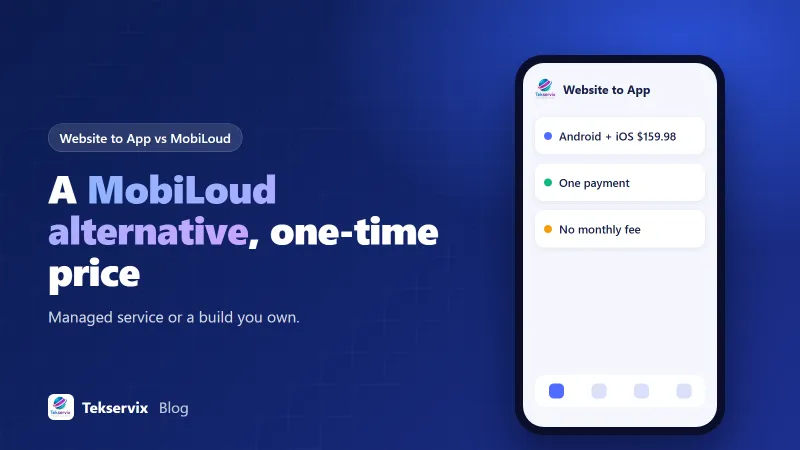
A MobiLoud alternative comes up when an online store looks at the price of a managed app and asks whether it needs all that service. MobiLoud builds and maintains an app for you, and listings put it at around $399 a month, which is a fair price for what it does if your store has the revenue. Tekservix Website to App is the do-it-yourself alternative: $159.98 once for Android and iOS together, with unlimited updates and no monthly fee. That's less than half of one month of MobiLoud, for good.
We couldn't read MobiLoud's own pricing page on 30 October 2026, so we're using listings from Software Advice and Capterra. They differ, so ask MobiLoud for a real quote.
Cost compared#
| Website to App | MobiLoud (listed) | |
|---|---|---|
| Up-front | $59.99 Android, $99.99 iOS, $159.98 both | Setup fee mentioned by some listings, near $850 |
| Monthly | $0 | About $399 entry, $799 and $1,499 higher tiers |
| Year 1 | $159.98 | About $4,800 or more |
| Over 3 years | $159.98 | About $14,000 or more |
| Who does the work | You, with help available | MobiLoud's team |
| Free trial build | Yes, on Android | Ask them |
Why you might want a MobiLoud alternative#
Managed services are priced for stores where an app can add real money. If an app lifts a store's revenue by a few thousand dollars a month, $399 is a bargain. For a smaller store, a gym, a school or a local chain, the sums don't work. You'd need to make an extra $4,800 a year from the app just to break even.
Website to App changes that calculation. At $159.98, the app only has to bring in a handful of orders to pay for itself, and after that, there's nothing more to pay. That lets businesses that could never justify a subscription have an app anyway.
What you get for one payment#
- Native Android and iOS apps built from your live website.
- A free Android test app, with three test builds a month.
- Your own signing key and your own store listings.
- Push notifications through your Firebase or OneSignal account.
- No Tekservix branding.
- Unlimited updates.
- Store publishing help and a 12-tester service for Google Play, if you want them.
Since the app shows your real site, your catalogue, cart and checkout all work the way they do on the web. Change a price on your store and it changes in the app straight away.
What MobiLoud does better#
It does the work for you. That's the whole point, and we shouldn't play that down.
A managed service builds the app, adapts it to your store, handles the submission, deals with Apple's review and looks after updates. If you've got a busy e-commerce team and no one who wants to think about signing keys, you're buying time and peace of mind. It also tends to be stronger on polish, with native-feeling navigation adapted specifically for your store.
For stores with big traffic, its account team can also advise on push campaigns and app growth. We don't offer that level of service in a one-time product. If you want something closer to it from us, custom development gives you a fixed-price quote, and our Care plan at $25 a month covers ongoing help.
The maths on when an app pays off#
Here's a simple way to think about it. Take your average profit per order. Divide the app's yearly cost by that number. That's how many extra orders it needs to bring in each year.
| Profit per order | Orders to pay for Website to App (once) | Orders to pay for $4,800 a year |
|---|---|---|
| $5 | 32 | 960 |
| $20 | 8 | 240 |
| $50 | 4 | 96 |
A store with thousands of orders a month will clear either target easily. A shop with a hundred orders a month will clear the first in weeks and may never clear the second.
Push notifications: the feature that pays#
The main reason to have a store app is the ability to reach customers without paying for ads. A well-timed push about a sale or a restock lands on the lock screen. You'll get that with both options. On Website to App, you use your own Firebase or OneSignal account, so you own your subscriber list and pay those providers directly, and both have free tiers at modest volume.
Don't overdo it. Two or three useful pushes a month beat a daily nag. Our article on OneSignal versus Firebase helps you choose between the two.
Who's likely to install your app?#
An app rarely brings in new customers on its own. It works best with people who already buy from you, which is why repeat-purchase businesses benefit most. Think of a coffee subscription, a pet food store, a grocery delivery service or a salon with regulars. If your customers buy once every few years, as with a mattress or a sofa, few will keep an app on their phone.
So before you spend anything, look at your repeat-purchase rate. If a good share of your customers come back every month or so, an app can earn its place. Promote it where those people already are: on order confirmation emails, on parcel inserts and in a banner on your site for returning visitors. A printed QR code in the box costs almost nothing, and our QR code generator can make one with your logo.
What happens if you outgrow a one-time app?#
It's a nice problem to have. If your app takes off and you need custom native screens or a dedicated team, you can move up without having wasted anything. The app's listing, reviews and signing key are yours, so a more advanced build can replace the wrapper as an update. Your customers keep the same app on their phones. The $159.98 will have paid for itself long before you get to that point.
Getting through app review#
This is where a managed service earns its fee, so let's be honest about it. Apple can reject thin wrappers under its minimum functionality rule. You can avoid most trouble by making sure your site's mobile experience is good, by adding push and a tab bar, and by supplying clear review notes with a demo login if your store needs one. If you sell digital goods, check the store rules on in-app purchases as well.
If you'd rather not deal with this yourself, we offer store publishing as a service, at far less than a monthly retainer.
A quick way to decide#
- Over $1 million a year in online sales, small mobile team, want it handled: talk to MobiLoud.
- Under that, or watching costs: start with Website to App.
- Not sure whether customers will install an app at all: try the cheap route first.
Those thresholds are our opinion rather than a rule, so adjust them for your margins.
Our recommendation#
Don't start with a monthly contract to test an idea. Build the free Android version on the Website to App page, send it to a few loyal customers and see if they use it. If it proves valuable and you later want a managed service, nothing stops you from moving up. Our guide to e-commerce apps versus mobile websites goes further on whether a store needs an app at all, and the best website to app builders roundup shows the rest of the market.
Frequently asked questions
How much does MobiLoud cost?
We couldn't read its own pricing page, and listings differ. Software Advice and GetApp show about $399 a month as the entry plan, while others show lower figures, and some mention a setup fee near $850. Ask MobiLoud for a current quote.
Is MobiLoud worth it?
For a store with high revenue and no appetite for managing an app, a done-for-you service can pay for itself. For a smaller business, a monthly fee in the hundreds is hard to recover from app sales alone.
Can a one-time app builder handle an online store?
Yes. A wrapped app shows your live store, including your cart and checkout, and your stock and prices update by themselves. Test logins and payments carefully in the free build.

Tekservix Team
The team behind Tekservix
The Tekservix Team builds and supports Tekservix: WhatsApp and SMS APIs, AI tools, invoicing, PDF and SEO tools for growing businesses. We write practical, tested guides based on what we see our customers do every day.
More articles from the Tekservix Team