WATI Alternative: When a Simpler WhatsApp API Fits Better
An honest look at a WATI alternative: what WATI offers on Meta's official API, how its pricing adds up, when a per-number gateway like WAservix costs less, and which teams should stay with WATI.
On this page
WATI is one of the best-known platforms for running WhatsApp on Meta's official API, with a shared inbox, broadcasts and chatbot flows. It's also more than many businesses need. If your goal is to send order updates, reminders and replies from your own software, or your monthly bill keeps rising with every user and message, you may be looking for a WATI alternative. This comparison sets out what each option is good at, honestly, including when you should stay put.
What WATI offers#
WATI is a business messaging platform on top of the official WhatsApp Business API. Its main features:
- A shared team inbox, where several agents answer customers from one WhatsApp number, with assignment and notes.
- Broadcast campaigns using Meta-approved message templates.
- A no-code chatbot builder for menus and automated flows.
- Integrations, including a Shopify add-on and an API.
- Official API status, which includes Meta's business verification process.
For a support team of five agents handling hundreds of chats a day, that combination is valuable.
How WATI's costs add up#
WATI's pricing page lists Growth, Pro and Business plans, billed monthly or annually, with a set number of users included. Several cost layers stack on top of the plan:
- Additional users, listed at $24 or $69 per user per month depending on the plan.
- Meta's message fees for marketing, utility and authentication templates, charged per message and varying by country. Meta explains these in its WhatsApp Business Platform pricing documentation.
- Add-ons, such as the Shopify integration at $4.99 a month, extra numbers and extra automation.
Check the pricing page for current plan prices in your region, since they change and differ between monthly and annual billing. The point is structural: you pay for the platform, the seats and the messages separately. Our guide to WhatsApp Business API pricing breaks down Meta's part.
The alternative: a WhatsApp API for your own number#
WAservix takes a different approach. It links your existing WhatsApp or WhatsApp Business number like WhatsApp Web does, and gives your software a REST API:
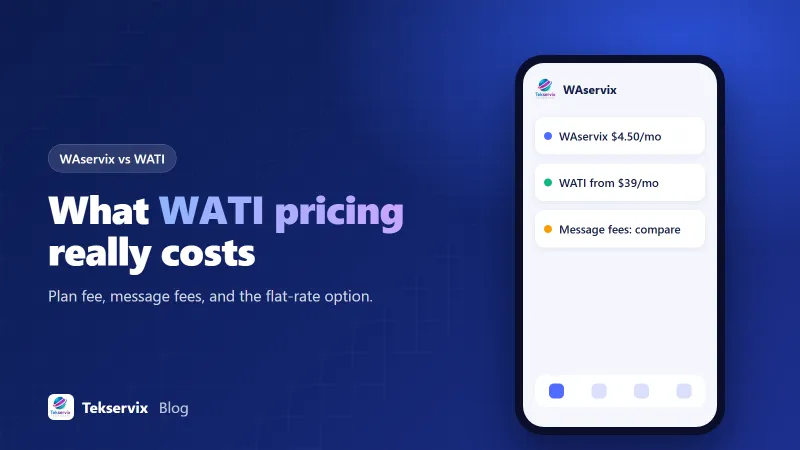
- Flat price per number: $4.50 a month for one, $12 for three, $22 for six, $35 for ten and $79 for 25, with unlimited messages and no per-message Meta fees. A three-day trial costs $1.
- No template approval: send the message that fits, in your own words.
- Webhooks for incoming messages, delivery and read receipts.
- Bulk campaigns with personalisation, safe pacing and automatic STOP opt-outs.
- Keyword auto-replies around the clock.
- Several numbers in one account, each with its own key and webhook.
What you give up#
A fair comparison has to list these clearly:
- No shared team inbox. WAservix is an API and campaign tool. If several agents need to answer chats in one interface, WATI or a similar platform does that; WAservix doesn't.
- No drag-and-drop chatbot builder. You can build bots through the API and webhooks, which suits developers, not non-technical teams.
- Not Meta's official API. Numbers that spam or get reported can be restricted by WhatsApp. Message people who opted in, and warm up new numbers slowly; see our guide to WhatsApp opt-in best practices.
- No official business verification through this route.
Who should stay with WATI#
- Support teams with several agents sharing one number all day.
- Marketing teams that rely on the visual chatbot builder and template broadcasts.
- Businesses that need the official API for compliance, partners or high-volume authentication.
- Shopify stores using WATI's ready-made integration and happy with the cost.
Who a simpler API suits#
- Developers connecting WhatsApp to their own app, shop or CRM.
- Businesses sending transactional messages: confirmations, delivery updates, reminders.
- Small teams where one or two people answer customers from the phone or WhatsApp Web anyway.
- Agencies running several client numbers on a predictable budget.
Our comparison of the WhatsApp API and the WhatsApp Business app helps if you're unsure which level you need.
Moving over without disruption#
- Start with one use case, such as order confirmations, on a separate number or alongside WATI.
- Move your sending code to the WAservix
send-messageendpoint and point a webhook at your server for replies. Code examples for PHP, Python and Node.js are in the API documentation, and our guide to WhatsApp webhooks covers the receiving side. - Bring over consent records, not just phone numbers. Only message people who agreed.
- Keep WATI running until the new flow has worked for a few weeks, then decide.
If you're coming from WaSender rather than WATI, the endpoints already match; see our WaSender API alternative article.
A worked example#
Imagine [Shop name], an online pharmacy with two staff answering WhatsApp. They use WATI mainly to send order and delivery updates from their website, plus a weekly health-tips broadcast. Their monthly bill covers the plan, an extra user and Meta's utility and marketing template fees. Looking closely, they find they never use the chatbot builder, and their two staff mostly reply from their phones. They move order updates to one WAservix number through the API, keep the broadcast only for customers who opted in, and answer chats in WhatsApp as before. Their messaging cost becomes one flat monthly fee. A larger competitor with eight agents sharing one number, meanwhile, would be right to stay on WATI for the team inbox alone.
Frequently asked questions
What is WATI used for?
WATI is a platform built on Meta's official WhatsApp Business API. Businesses use it for a shared team inbox, broadcast campaigns with approved templates, chatbot flows and integrations such as Shopify. You pay a monthly plan based on features and users, plus Meta's per-message fees.
Is there a cheaper alternative to WATI?
If you mainly need to send and receive WhatsApp messages from your own systems, a gateway like WAservix costs from $4.50 a month per number with unlimited messages and no Meta fees. It is not Meta's official API, so it suits businesses messaging customers who already know them, and it has no shared team inbox.
Should I switch from WATI to an unofficial WhatsApp API?
Only if you don't rely on WATI's team inbox, chatbot builder or official-API features, and you can follow WhatsApp's rules on consent carefully. Teams with several agents answering customers all day are usually better off staying on a platform built for that.

Tekservix Team
The team behind Tekservix
The Tekservix Team builds and supports Tekservix: WhatsApp and SMS APIs, AI tools, invoicing, PDF and SEO tools for growing businesses. We write practical, tested guides based on what we see our customers do every day.
More articles from the Tekservix Team