SMS for Microfinance and Credit Unions: Reminders, Alerts and Codes That Members Trust
How credit unions and microfinance institutions use SMS: repayment reminders, deposit confirmations, meeting notices and verification codes, what to keep out of a text, consent, and a low-cost setup with your own SIM.
On this page
For a credit union or microfinance institution, a missed repayment is rarely a decision. More often the member forgot the date, was unsure of the amount, or didn't know whether last week's deposit arrived. A short text at the right moment fixes most of that. SMS for microfinance works because it reaches every member on every phone, including basic phones without data, at almost no cost per message.
This guide covers the messages that make the most difference, what never to put in a text, how to handle consent and opt-outs, and a setup that a small institution can run itself.
Why SMS still fits microfinance#
- It reaches everyone. Many members, especially outside cities, use feature phones. SMS needs no app and no data bundle.
- It is read. A text arrives with a sound and sits in the inbox until opened. People check them far more reliably than email.
- It creates a record. A confirmation SMS gives the member proof of a deposit, which cuts disputes at the counter.
- It is cheap enough to send often. A reminder that prevents one late payment pays for thousands of messages.
The messages that matter most#
Start with these five. Together they cover most of the questions members phone the office about.
- Repayment reminders. Three days before the due date, and again on the day. Include the amount, the date and how to pay.
- Payment and deposit confirmations. Sent as soon as money is recorded. "We received £10 on 12 Nov. Thank you."
- Overdue notices. Polite, factual and with a phone number. The goal is a conversation, not a threat.
- Meeting and training notices. General assemblies, group meetings, financial literacy sessions, with the date, time and place.
- Verification codes. One-time codes for mobile app logins or withdrawal requests. Our guide to SMS OTP verification covers how to do this safely.
Writing a good repayment reminder#
A reminder has one job: make paying on time easy. Compare these two:
- Weak: "Dear member, kindly be reminded to pay your loan. Management."
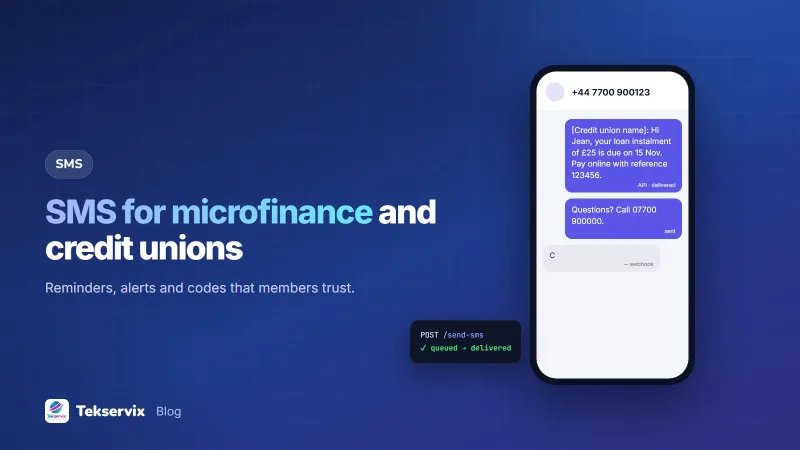
- Clear: "[credit union name]: Hi Jean, your instalment of £25 is due on 15 Nov. Pay online with reference 123456. Questions? Call 07XXX XXXXXX."
The second names the institution first, uses the member's name, states the exact amount and date, and says how to pay. It fits in one or two SMS segments; our article on the SMS character limit explains how length affects cost, especially if you write in a language with special characters.
Personalising each message by hand is impossible for thousands of members. Instead, export a list from your core banking or loan system with columns for name, amount and due date, and let the SMS tool fill them in. Our guide to personalised bulk SMS shows how column placeholders work.
What to keep out of a text message#
An SMS shows on the lock screen and stays on the phone. Phones are shared within families and lost often. Keep financial detail to the minimum a member needs:
- No full account or loan numbers. Use the last three or four digits if you must refer to an account.
- No full balances in routine messages. The amount due is enough. Members can check balances at the office or in the app.
- No PINs or passwords, ever. And tell members, regularly, that staff will never ask for their PIN by SMS or phone.
- No links in reminders unless members already know your web address. Fraudsters copy institutions' messages and add a fake link.
Data protection laws such as the GDPR set rules for how personal information is collected and used; your national data protection authority publishes guidance. Microfinance institutions and credit unions are also supervised by financial regulators, so check any sector rules on customer communication with your compliance officer.
Consent and opt-outs#
Service messages about a member's own loan or savings are expected, and most members welcome them. Marketing messages, such as a new loan product or a savings promotion, are different: send them only to members who agreed, and let anyone stop them. Add a consent line to the membership form, record the date, and honour STOP replies. Our article on SMS opt-outs covers how this works in practice.
A low-cost setup with your own SIM#
Large banks use aggregators with branded sender names and per-message billing. A credit union with a few thousand members can start more cheaply. SMS Gora turns an Android phone with your institution's SIM card into an SMS gateway:
- Bulk campaigns from a CSV file, with placeholders such as name and amount filled in for each member, sent at a safe pace.
- Scheduling, so reminders go out on the right morning without anyone at the keyboard.
- An inbox in the browser where staff read and answer member replies, sent from the same SIM.
- Keyword auto-replies, for example a member texting "HOURS" gets your opening times.
- Automatic STOP handling and an API if your loan software can send messages itself.
Plans start at $3.99 a month for one phone with unlimited messages through the software. The texts themselves are billed by your mobile operator, like messages sent by hand, so an SMS bundle on the SIM keeps costs predictable. Members see your institution's phone number, which they can save and call back. Our guide to bulk SMS costs and rules compares this with SMS provider options.
Measure what changes#
Track two numbers before and after you start: the share of instalments paid on or before the due date, and the number of phone calls asking about amounts and dates. Most institutions see both move within two or three repayment cycles. Keep an eye on replies, too. Members often answer a reminder with a question, and fast answers turn a possible default into a rescheduled payment.
A worked example#
Imagine [credit union name], a savings and credit cooperative with 2,400 members, about 900 of them with active loans. Loan officers spend Monday mornings phoning members who missed Friday's instalment. The credit union links one Android phone with an SMS bundle to SMS Gora, exports the loan schedule each week, and schedules two reminders per instalment: three days before and on the due date. Deposits recorded at the counter trigger a confirmation text. Within three months the Monday call list is noticeably shorter, members stop queueing to ask whether their deposit arrived, and loan officers spend their time on the members who genuinely need a new repayment plan.
Frequently asked questions
Why do credit unions use SMS instead of WhatsApp?
Many members, especially in rural areas, use basic phones without data. SMS reaches every phone on every network without an internet connection, so it remains the most reliable channel for reminders and confirmations. WhatsApp can be added for members who prefer it.
What should a loan repayment reminder SMS say?
Keep it short and specific: the institution's name, the amount due, the due date and how to pay, for example the payment link. Avoid full account numbers and balances, and give a phone number members can call if they have a problem.
How much does bulk SMS cost for a microfinance institution?
With an Android SMS gateway such as SMS Gora, you pay a flat monthly fee for the software, from $3.99 per phone, and your mobile operator charges for the messages under your SIM's plan or bundle. Aggregator services charge per message instead, which costs more at high volumes but can offer a branded sender name.

Tekservix Team
The team behind Tekservix
The Tekservix Team builds and supports Tekservix: WhatsApp and SMS APIs, AI tools, invoicing, PDF and SEO tools for growing businesses. We write practical, tested guides based on what we see our customers do every day.
More articles from the Tekservix Team